
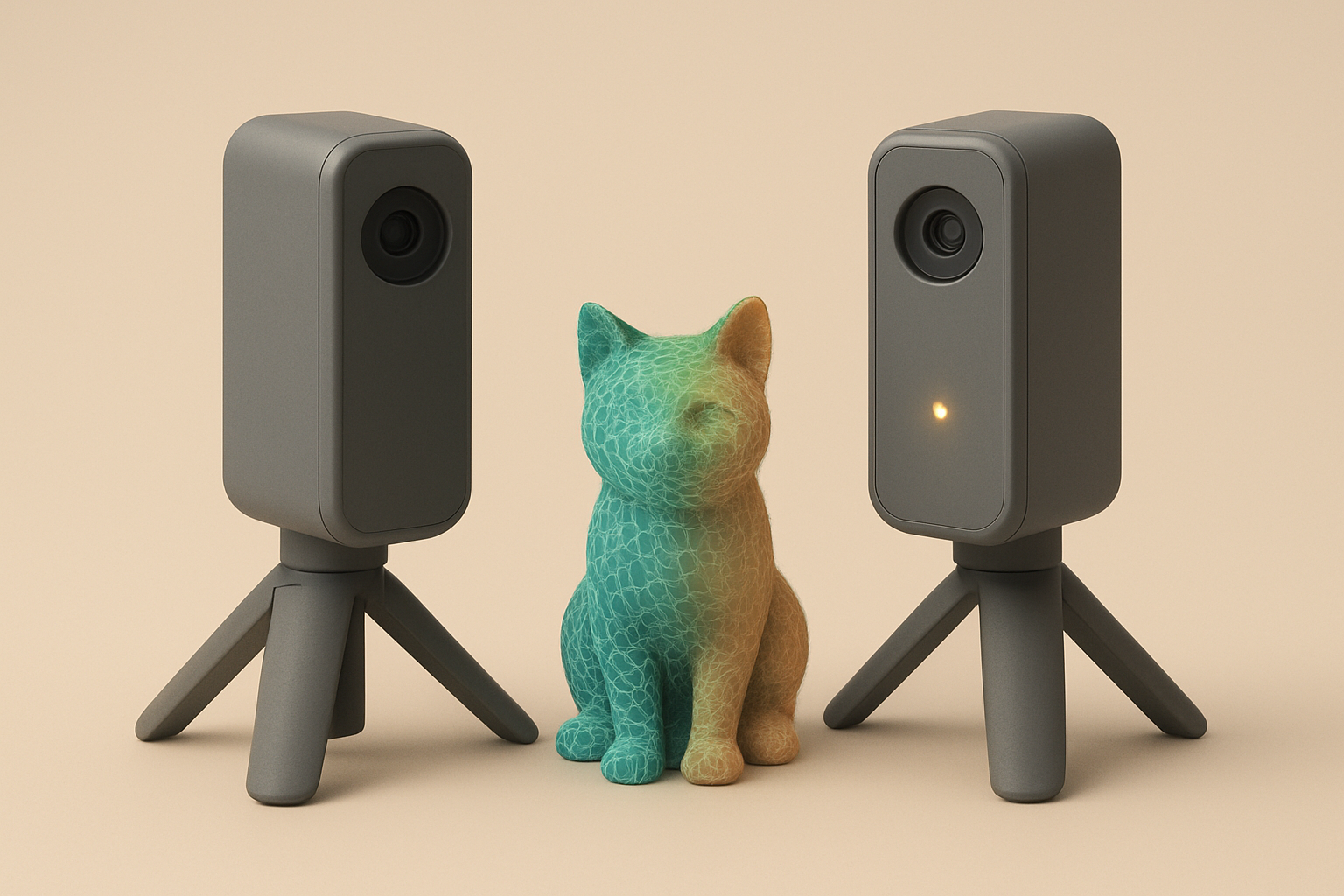
Revopoint’s Pop 3 replaces the Pop 2 as the entry point into the company’s binocular structured-light lineup, and the two scanners sit closer in price than the generation gap suggests. Per manufacturer specs, accuracy figures barely move — the real upgrade case rests on full-color texture capture, a newer software generation, and current availability rather than a dramatic precision jump.
At a Glance
| Category | Pop 3 | Pop 2 |
|---|---|---|
| Price (Sept 2026) | $659-699, Revopoint official store | $699 retail list (discontinued, per Kickstarter/3DSourced) |
| Headline feature | Full-color texture standard on every scan | Adjustable 0.2m-2m working range with turntable option |
| Deciding spec | Full-color texture built into Pop 3’s core capture pipeline vs. Pop 2’s 4K texture as a secondary capability on an older-generation sensor and software stack | |
Full Spec Comparison
| Axis | Pop 3 | Pop 2 |
|---|---|---|
| Accuracy | Single-frame accuracy up to 0.1mm per Revopoint’s published specs | Claimed up to 0.1mm; community test data from independent calibration testing measured around 0.07mm in practice |
| Resolution | 0.05mm point distance/resolution | Highest single-frame precision reaches 0.05mm |
| Capture Speed | 12-18fps | Up to 1,000,000 points/sec |
| Working Volume/Range | Minimum scan volume 20x20x20mm | Adjustable 0.2m-2m, minimum 20x20x20mm |
| Tracking | Binocular dual-camera infrared structured light | Binocular and micro-structured light via proprietary micro-projecting chip |
| Weight | Not separately published by Revopoint for direct comparison | Not separately published by Revopoint for direct comparison |
| Computer Requirements | Runs on Revo Scan 5; manufacturer does not publish a distinct hardware spec sheet beyond the app | USB 3.0 tethered connectivity to a host PC; usable handheld or stationary with a turntable |
| Software & Subscriptions | Free Revo Scan 5, no subscription required for core features | Revo Scan (earlier generation), texture resolution up to 4K |
| Price | $659-699 as of September 2026, Revopoint official store | $699 retail list as of September 2026, per Kickstarter/3DSourced (original crowdfunding pricing was $399-524, now discontinued) |
Where Pop 3 Wins
Pop 3’s standout advantage is full-color texture capture built into the core scan, not bolted on as an extra step. For anyone scanning figurines, cosplay props, or objects where surface color and detail matter as much as geometry, that’s a workflow win Pop 2 can’t match out of the box.
The bundled Revo Scan 5 software is the newer generation of Revopoint’s processing pipeline, and running on current software means ongoing updates and feature support land on Pop 3 first. Pop 3 is also the model Revopoint currently sells and supports, which matters for buyers who want long-term parts, firmware, and customer-service continuity rather than a discontinued product.
Free core-feature software with no subscription keeps the total cost of ownership predictable, which is a meaningful edge for hobbyists and small studios watching every line item on a budget.
Where Pop 2 Wins
Pop 2’s adjustable 0.2m-2m working range, paired with turntable-based stationary scanning, gives it flexibility for larger objects and repeatable studio setups that Pop 3’s spec sheet doesn’t explicitly call out. That range makes Pop 2 a stronger fit for anyone scanning furniture-sized objects or running a fixed capture rig.
Its raw capture speed, rated up to 1,000,000 points per second, is a headline number that can matter for fast-moving handheld passes over large surfaces. And per community test data from independent calibration testing, real-world accuracy has been measured around 0.07mm, edging past its own 0.1mm claim.
Where a used or discounted Pop 2 is available below its $699 list, it remains a capable scanner for buyers who don’t need color texture as a core requirement.
Verdict: Is the Upgrade Worth It?
Buyers who already own a Pop 2 and only scan for geometry — reverse engineering, mechanical parts, print-ready meshes without color — can reasonably stick with it, especially if a turntable setup is already in place. Buyers starting fresh, or those who need color texture and want current-generation software and support, should put their money into the Pop 3 at a comparable price point. For more on how we build these comparisons, see our editorial policy.
Frequently Asked Questions
Is the Pop 3 significantly more accurate than the Pop 2?
Not dramatically. Both list single-frame precision around 0.05mm and accuracy claims near 0.1mm per manufacturer specs. Community test data on Pop 2 measured closer to 0.07mm in independent calibration testing, so the accuracy gap between the two generations is smaller than marketing generations might suggest.
Can the Pop 2 still be bought new in September 2026?
Pop 2 has been discontinued and replaced in Revopoint’s current lineup, per Kickstarter and 3DSourced reporting, so new units typically show up through resellers or remaining retail stock rather than Revopoint’s own store, where Pop 3 is the active model.
Does either scanner require a subscription to use?
No. Pop 3 ships with free Revo Scan 5 software and no subscription for core features, and Pop 2 used an earlier free Revo Scan release. Neither model locks essential scanning and processing functions behind a paid tier.