
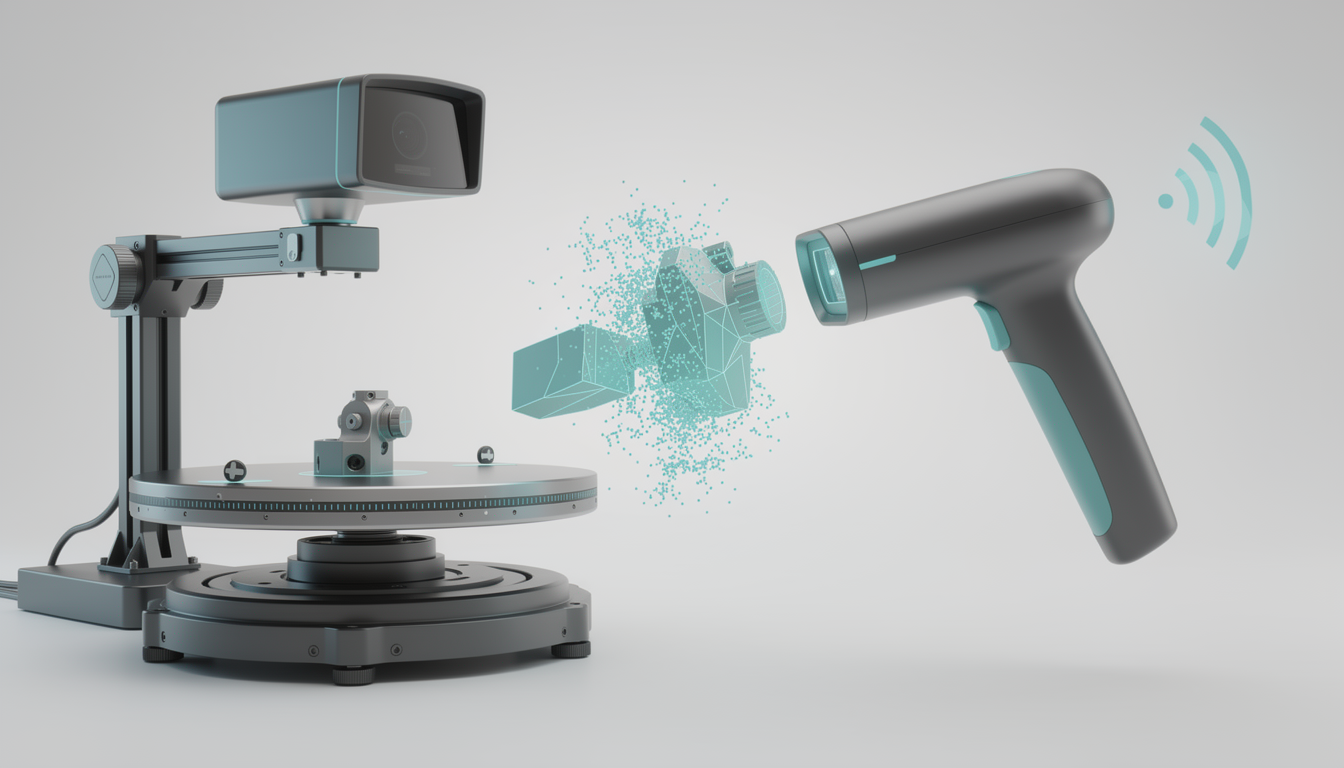
Revopoint’s Metro X and Metro Y are both metrology-grade blue-laser 3D scanners built for engineers and reverse-engineering work rather than casual hobby scanning. Metro X pairs its laser with full-field structured light for very fast full-surface capture and ships with a complete turntable rig at a lower price; Metro Y is a laser-only, Wi-Fi 6 wireless unit tuned for fine, complex geometry at a higher cost.
At a Glance
| Category | Metrology-grade blue-laser 3D scanner |
|---|---|
| Metro X | Hybrid laser + full-field structured light, bundled turntable rig, $999 list |
| Metro Y | Laser-only, finer line pattern, Wi-Fi 6 wireless, $1,071 |
| Deciding spec | Metro X: up to 7,000,000 pts/sec full-field capture. Metro Y: 30 cross / 15 parallel laser lines for finer detail |
Full Spec Comparison
| Axis | Metro X | Metro Y |
|---|---|---|
| Accuracy | Up to 0.02mm; volumetric accuracy 0.02mm + 0.04mm x L(m) | Overall accuracy up to 0.02mm; single-frame repeatability up to 0.01mm; volumetric accuracy 0.02mm + 0.04mm x L(m) |
| Resolution | Blue laser: 14 crossed lines / 7 parallel lines; plus full-field structured light at 62 lines; 4 scanning modes total | Multi-line blue laser: 30 cross lines / 15 parallel lines, plus a single-laser mode for fine detail |
| Capture Speed | Up to 7,000,000 points/sec (full-field structured-light mode); up to 2,000,000 points/sec (multi-line laser mode); up to 60fps | Not published in manufacturer’s specs |
| Working Volume/Range | Field of view from 160x70mm at 200mm distance to 320x215mm at 400mm distance | Maximum scan volume 1x1x1m |
| Tracking | Dual-axis turntable and calibration markers included, suited to fixed-setup scanning | Handheld, marker-based, untethered via Wi-Fi 6 |
| Weight | Not published in manufacturer’s specs | Not published in manufacturer’s specs |
| Computer Requirements | Not published in manufacturer’s specs | Not published in manufacturer’s specs |
| Software & Subscriptions | Revo Metro (scan/edit/export) and Revo Design (scan-to-CAD), free with purchase, no subscription for core features | Revo Metro (scan/edit/export) and Revo Design (scan-to-CAD), free with purchase, no subscription for core features |
| Price | $999 list, promotional pricing as low as $649 (Revopoint official store / 3D Printing Industry, as of September 2026) | $1,071; Metro Y Pro $1,428 (Revopoint official store, as of September 2026) |
Where Metro X Wins
Metro X’s biggest edge is speed: per the manufacturer’s published specs, its full-field structured-light mode captures up to 7,000,000 points per second, well ahead of what a laser-only unit like Metro Y typically manages for broad surfaces. It also ships as a complete kit — tripod, scanner cradle, dual-axis turntable, calibration board, markers and carrying case — so buyers get a functioning metrology setup without sourcing accessories separately. At $999 list, with promotional pricing reported as low as $649, it undercuts Metro Y by a wide margin while still hitting 0.02mm accuracy. For engineers who need to digitize full parts quickly and want a turntable workflow ready out of the box, that combination of speed, completeness and price is hard for Metro Y to match.
Where Metro Y Wins
Metro Y is built for the detail work Metro X’s structured-light mode isn’t optimized for. Its laser pattern — 30 cross lines and 15 parallel lines, plus a dedicated single-laser mode — is markedly denser than Metro X’s 14/7 arrangement, and its single-frame repeatability reaches 0.01mm versus specs that only state overall accuracy for Metro X. That finer resolution suits complex, fiddly geometries where a coarser hybrid scan would miss features. Metro Y also adds an integrated HD RGB camera for color and texture capture, and Wi-Fi 6 connectivity lets it scan fully untethered, which Metro X’s turntable-centric setup doesn’t offer. For studios digitizing intricate parts, or working in tight spaces where trailing cables are a problem, those capabilities justify the higher price.
Verdict: Which Should You Buy?
Buyers who want fast full-surface capture, a ready-to-run turntable rig and the lower entry price should choose Metro X, especially for reverse-engineering workflows centered on complete parts. Buyers working on fine, complex, or color-critical geometry who value wireless freedom should choose Metro Y and accept the higher cost. For more on how we build these comparisons, see our editorial policy.
Frequently Asked Questions
Do Metro X or Metro Y require a software subscription?
No. Both scanners use Revopoint’s Revo Metro and Revo Design software, which are free with purchase and include core scanning, editing, export and scan-to-CAD features without a subscription, per the manufacturer’s published specs.
Which scanner is more accurate?
Both list overall accuracy up to 0.02mm and the same volumetric accuracy formula (0.02mm + 0.04mm x L(m)) per the manufacturer’s specs. Metro Y additionally publishes single-frame repeatability up to 0.01mm, reflecting its finer laser line density for detailed geometry, though this isn’t a directly comparable overall-accuracy figure for Metro X.
Can either scanner work without being tethered to a computer?
Metro Y supports Wi-Fi 6 connectivity for untethered scanning, per the manufacturer’s specs. Metro X’s published kit centers on a tripod, cradle and turntable setup, and Revopoint’s materials don’t list untethered wireless capture for it.