
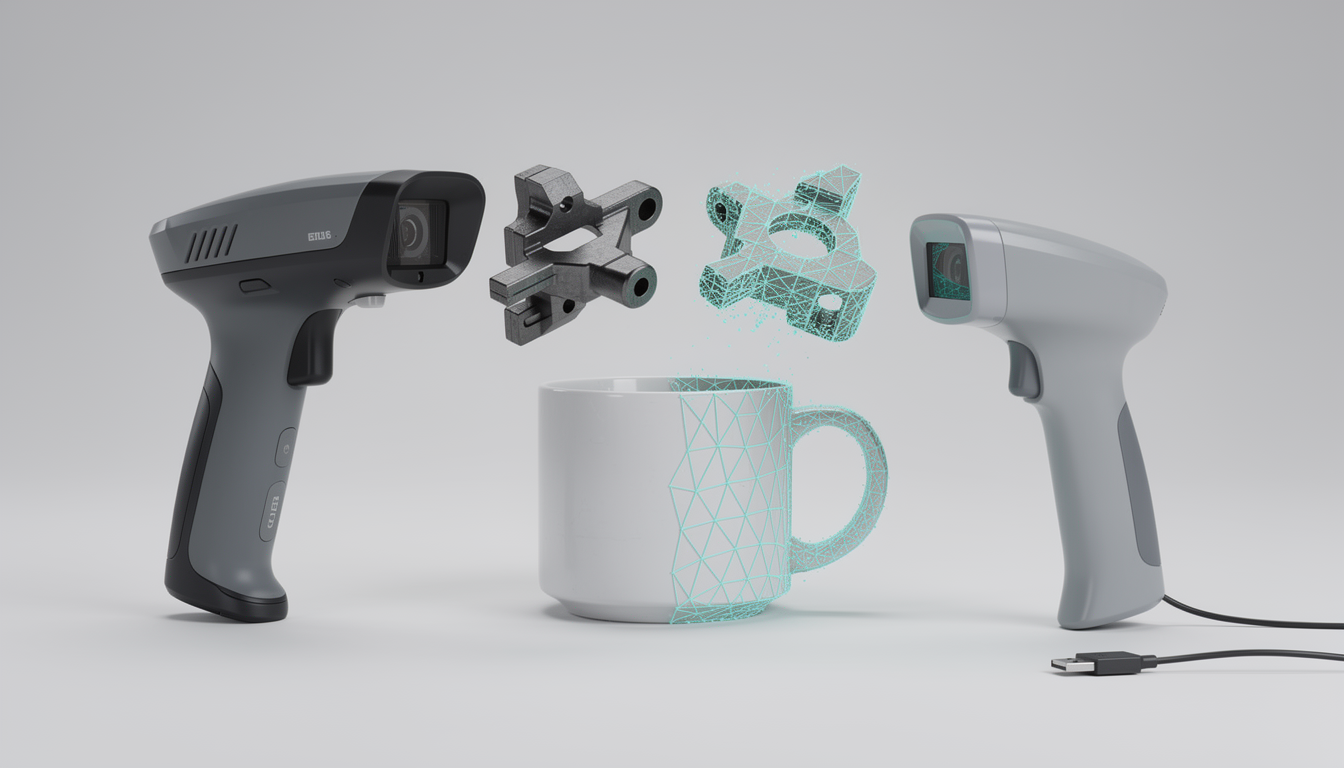
Buyers choosing between the Creality CR-Scan Otter and the Einstar are picking between two budget handheld 3D scanners aimed at hobbyists, engineers and small studios who don’t want to spend thousands. The Otter suits anyone who needs tighter accuracy and battery-free flexibility around tricky black or metallic surfaces, while the Einstar suits beginners who want the lowest entry cost and a simpler tethered setup with fewer settings to manage.
At a Glance
- Category: Entry-level handheld 3D scanners for hobbyists, engineers and small studios
- Creality Otter: $899, four-lens stereo vision, accuracy up to 0.02mm
- Einstar: $699-$759, tethered USB-only, accuracy up to 0.1mm
- Deciding spec: Accuracy — 0.02mm (Otter) versus 0.1mm (Einstar)
Full Spec Comparison
| Axis | Creality Otter | Einstar |
|---|---|---|
| Accuracy | Up to 0.02mm | Point distance accuracy up to 0.1mm |
| Resolution | 24-bit RGB camera, full-color capture | RGB color camera plus stereo depth sensing |
| Capture Speed | Anti-shake technology for smooth, reliable scanning | Scan speed up to 14fps |
| Working Volume/Range | Scans objects from 10mm to 2000mm | Standard handheld working range for small-to-medium objects |
| Tracking | Four-lens stereo vision system | Three infrared VCSEL projectors plus two stereo depth cameras |
| Weight | 390g | Lightweight handheld body, USB-tethered (no internal battery) |
| Computer Requirements | Connected PC required for processing | Connected PC required, powered entirely via USB |
| Software & Subscriptions | Creality scanning software bundled with device | Shining3D scanning software bundled with device |
| Price | $899 (Creality official store, as of September 2026) | $699-$759 (Vision Miner / Shining3D, as of September 2026) |
Where Creality Otter Wins
The Otter’s four-lens stereo vision system delivers accuracy up to 0.02mm per Creality’s published specs, a much tighter figure than the Einstar’s 0.1mm point distance accuracy. That precision matters for engineers checking part tolerances, reverse-engineering small components, or studios producing detail-heavy scans destined for 3D printing where surface fidelity shows up in the final print.
Its 24-bit RGB camera also captures full-color detail directly during the scan pass, and per the manufacturer’s published specs the Otter can scan black or metallic surfaces without applying anti-glare spray first — a prep step many budget scanners still require and one that adds cleanup time afterward. Combined with a working range from 10mm to 2000mm and anti-shake technology built in for smooth, reliable scanning even with less steady hands, the Otter covers a wider range of object sizes and tricky materials without extra prep work or a steep handling learning curve.
Where Einstar Wins
The Einstar’s biggest advantage is price: at $699-$759 (Vision Miner / Shining3D, as of September 2026) it undercuts the Otter’s $899 (Creality official store, as of September 2026) by a meaningful margin, which matters for hobbyists testing the waters before committing to pricier gear or a first purchase for a small studio on a limited startup budget.
Its all-USB tethered design also means no battery to charge, monitor or eventually replace mid-project — plug in and scan, with power drawn straight from the connected computer. With three infrared VCSEL projectors, two stereo depth cameras and a dedicated RGB color camera, the Einstar’s sensor stack keeps setup straightforward for first-time users who want a capable scanner without juggling battery life or a steep learning curve, and its scan speed of up to 14fps per Shining3D’s specs keeps casual capture sessions moving briskly.
Verdict: Which Should You Pick?
Engineers, technical hobbyists and small studios that need finer accuracy and the ability to scan black or metallic parts without spray coating should lean toward the Creality Otter. Absolute beginners on a tighter budget who want a simple, battery-free, plug-and-scan experience will likely be happier with the Einstar. For more on how we build these comparisons, see our editorial policy.
Frequently Asked Questions
Which scanner is better for scanning metallic or reflective parts?
The Creality Otter is the stronger choice here. Per the manufacturer’s published specs, its four-lens stereo vision and 24-bit RGB camera let it capture black or metallic surfaces without applying anti-glare spray first, which saves prep time on reflective parts.
Do either of these scanners need a laptop or PC connected while scanning?
Yes, both require a connected computer to run their scanning software and process capture data in real time. The Einstar is additionally USB-powered with no internal battery, so it must stay tethered throughout the scan.
Is the price gap between the Otter and Einstar worth it?
It depends on the use case. The roughly $150-$200 difference (Otter at $899 vs. Einstar at $699-$759, as of September 2026) buys a tighter 0.02mm accuracy spec and spray-free scanning of tricky surfaces — valuable for engineering or professional work, but possibly unnecessary for casual hobbyist projects like scanning toys, cosplay props or household objects for personal 3D printing.
Which scanner is easier for a complete beginner to learn?
Both are marketed as entry-level, but the Einstar’s simpler USB-tethered setup with no battery to manage removes one variable for first-time users. The Otter is still approachable, and its anti-shake technology helps smooth out early scanning attempts, but the Einstar’s streamlined hardware makes the initial learning curve slightly gentler.