
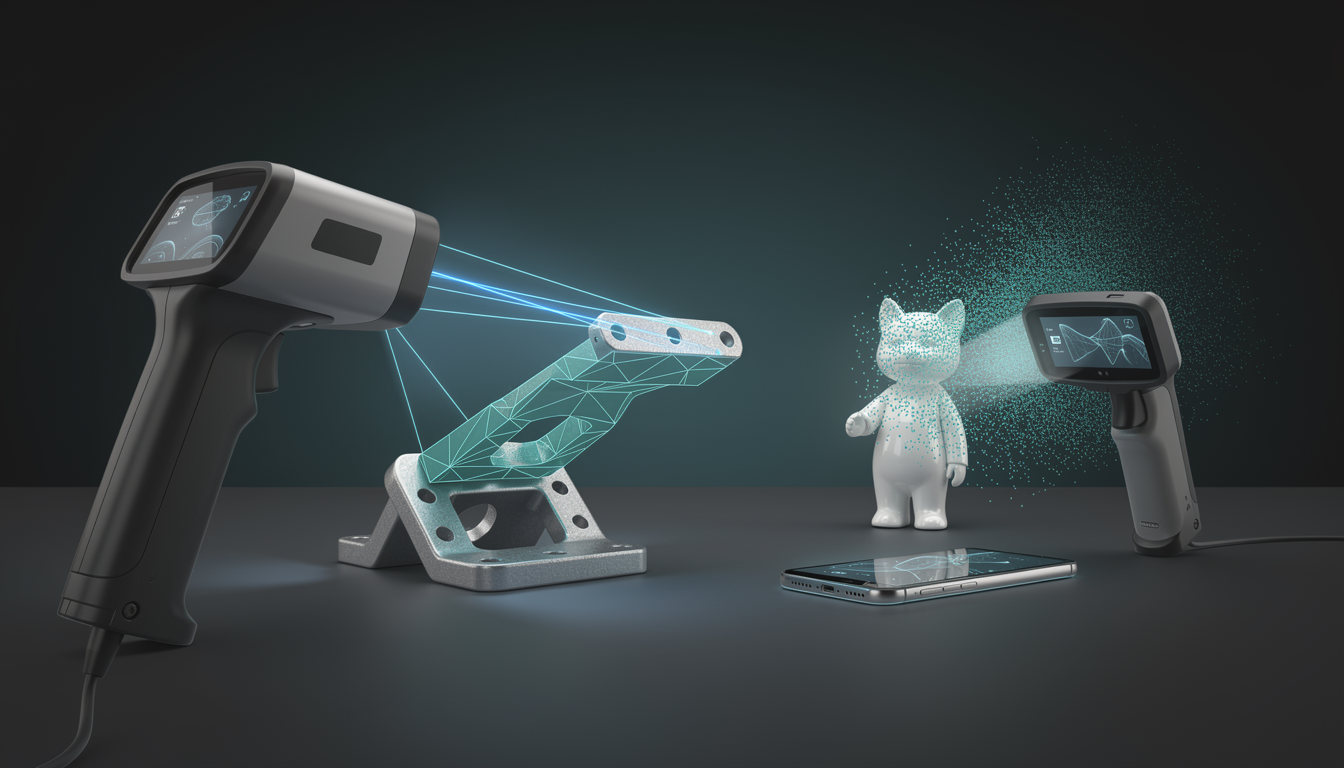
Buyers choosing between the Einscan Rigil and the Einstar Rockit are really choosing between two categories: a standalone professional laser scanner and a pocket handheld. Rigil suits metrology, reverse engineering and studio work; Rockit suits hobbyists, field capture and anyone scanning on a budget.
At a Glance
- Category: EinScan Rigil is a standalone professional laser scanner; Einstar Rockit is a pocket-size handheld scanner.
- EinScan Rigil: $4,999 list, built-in 6.4-inch touchscreen, works with no PC required.
- Rockit: $1,519 sale price, no screen of its own, tethers to a phone, tablet or PC.
- Deciding spec: Volumetric accuracy — Rigil rates 0.04mm + 0.06mm/m for professional-grade dimensional work; Rockit’s spec sheet leads with speed and portability instead.
Full Spec Comparison
| Axis | EinScan Rigil | Einstar Rockit |
|---|---|---|
| Accuracy | Volumetric accuracy of 0.04mm + 0.06mm/m, per Shining3D’s published specs | Not published as a volumetric accuracy figure by the manufacturer; positioned as a fast capture tool rather than a metrology instrument |
| Resolution | Geometric resolution up to 0.05mm | Not separately published; resolution is a function of point rate rather than a fixed geometric figure |
| Capture Speed | 25+25 crossed laser lines for high-speed scanning, plus 7 parallel laser lines for fine detail | Up to 2.8 million points/sec in Laser HD mode, 1.44 million points/sec in IR Rapid mode, using 38 crossed blue laser lines, 7 parallel blue laser lines and an IR VCSEL |
| Working Volume/Range | Not published as a single figure; designed for full-object professional capture across standalone, wireless and wired PC modes | Designed for close-range, pocket-scale capture; usable in ambient light up to 110,000 lux in laser mode |
| Tracking | Included calibration board and markers support marker-based alignment for demanding accuracy work | Geometry-based tracking from its crossed laser lines and IR VCSEL; no markers included |
| Weight | Not published by the manufacturer in the source specs | Genuinely pocket-size handheld form factor |
| Computer Requirements | None required in Standalone mode; optional Wireless PC mode (built-in Wi-Fi 6) or Wired PC mode | Requires a paired phone, tablet or PC screen to operate; built-in Wi-Fi for wireless pairing |
| Software & Subscriptions | Shining3D EXScan/EXStar-family software tied to the unit; check current Shining3D licensing terms before purchase | Shining3D scanning app for paired devices; check current Shining3D licensing terms before purchase |
| Price | $4,999 list (some resellers near $5,645), as of September 2026, Shining3D / 3DJake | $1,519 sale price, regular list $1,999, as of September 2026, 3DJake |
Where EinScan Rigil Wins
Rigil’s case for professional buyers rests on three specs. Its volumetric accuracy of 0.04mm + 0.06mm/m and geometric resolution up to 0.05mm target reverse-engineering and inspection work where Rockit’s spec sheet offers no comparable figure. Its 6.4-inch 2K AMOLED touchscreen and Standalone mode mean it captures scans with no PC tethered at all, something Rockit cannot do since it depends on a paired device’s screen. Dual replaceable 6,000mAh batteries also let a studio swap power mid-session rather than stopping to recharge, and the included calibration board and markers give it a structured accuracy workflow for parts that demand traceable results, including carbon, shiny metal or dark surfaces without spray, per Shining3D’s published specs.
Where Rockit Wins
Rockit’s case is price and portability. At $1,519 on sale versus Rigil’s $4,999 list, as of September 2026 per 3DJake, it costs roughly a third as much, putting it within reach of hobbyists and small studios testing whether 3D scanning fits their workflow at all. Its pocket-size handheld body goes places a screen-equipped rig cannot, and its Laser HD mode’s 2.8 million points/sec keeps pace with fast handheld capture. A 110,000 lux ambient-light rating in laser mode also means it can work outdoors or under bright shop lighting where some scanners struggle, per the manufacturer’s published specs.
Verdict: Which Should You Buy?
Choose the EinScan Rigil for metrology, reverse engineering or any studio work where 0.04mm-class accuracy and a screen-equipped standalone rig justify roughly three times the spend. Choose the Einstar Rockit for hobbyist projects, field capture and budget-conscious buyers who can work with a paired phone or tablet instead of a built-in display. For more on how we build these comparisons, see our editorial policy.
Frequently Asked Questions
Is the Einstar Rockit accurate enough for engineering work?
Shining3D does not publish a volumetric accuracy figure for Rockit the way it does for Rigil’s 0.04mm + 0.06mm/m rating, so buyers doing dimensional inspection or reverse engineering should lean toward Rigil; Rockit is positioned around capture speed and portability rather than metrology-grade precision.
Can the EinScan Rigil be used without a laptop?
Yes. Rigil’s Standalone mode runs entirely on its own integrated processing unit and 6.4-inch touchscreen, with Wireless PC mode and Wired PC mode available as options when a computer is preferred, per Shining3D’s published specs.
Why is there such a large price gap between two scanners from the same company?
Rigil and Rockit are sold under different Shining3D sub-brands aimed at different tiers: Rigil is the professional all-in-one laser line at $4,999 list, while Rockit is the budget pocket handheld at $1,519 on sale, both as of September 2026 per Shining3D and 3DJake, letting buyers pick a price point within the same manufacturer’s catalog.