
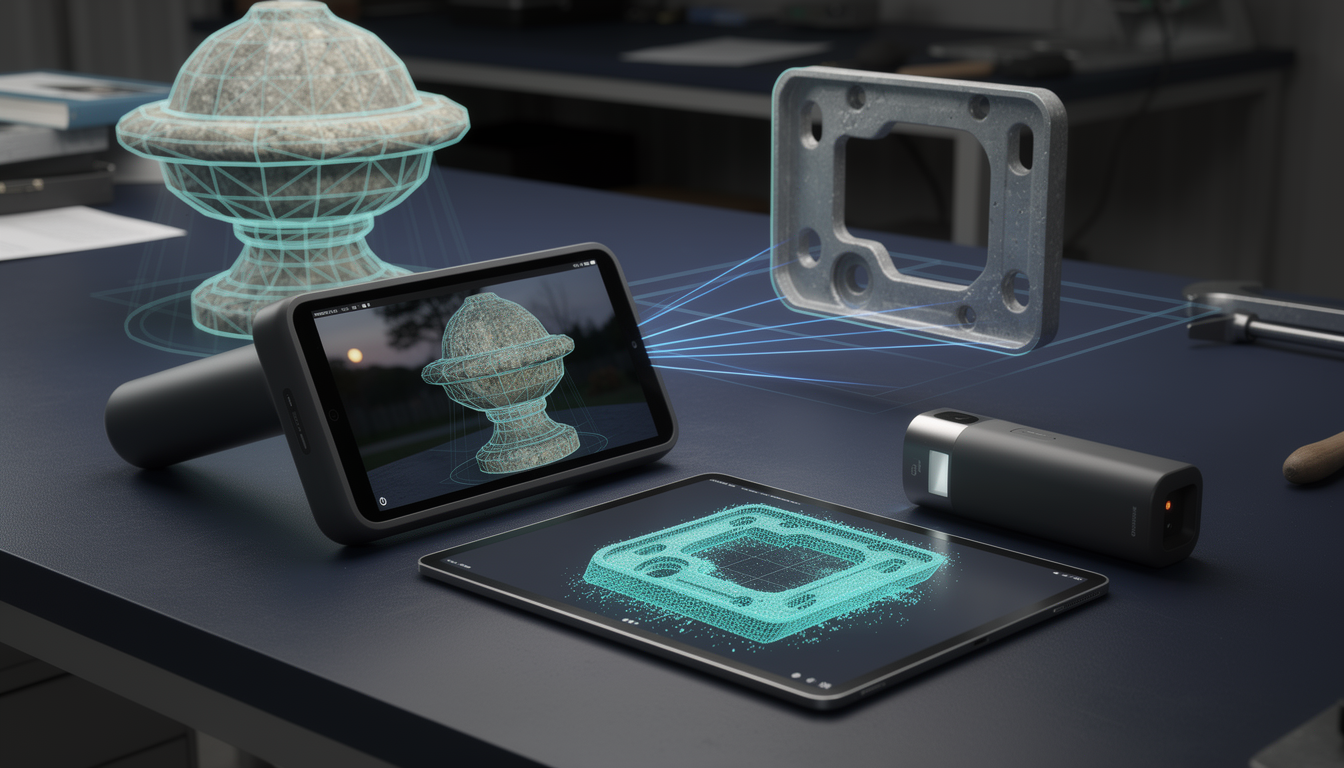
Anyone comparing the Einstar Vega and the Einstar Rockit is choosing between two handheld 3D scanners built around different workflows. The Vega is a standalone, all-in-one unit with its own built-in screen, so it captures without a paired computer. The Rockit is smaller and cheaper but tethers to a phone, tablet, or PC for live preview. Field techs who need independence should lean Vega; budget-conscious desktop users should lean Rockit.
At a Glance
| Category | Handheld 3D Scanner |
|---|---|
| Einstar Vega | Standalone, all-in-one with built-in screen — no computer required to scan, $1,699 |
| Rockit | Pocket-size, phone/tablet/PC-tethered for live preview, $1,519 |
| Deciding Spec | On-device screen and independence (Vega) vs. lower price and portability (Rockit) |
Full Spec Comparison
| Axis | Einstar Vega | Rockit |
|---|---|---|
| Accuracy | Not published as a directly comparable mm-level figure on the manufacturer pages cited here; buyers wanting head-to-head accuracy numbers should request them from Einstar before ordering. | |
| Resolution | 48MP color texture camera, per the manufacturer’s published specs | 5MP color texture camera, per the manufacturer’s published specs (geometric point-cloud resolution not separately published) |
| Capture Speed | Fast mode (infrared VCSEL) up to 20fps for medium/large objects; HD mode (infrared MEMS) for fine detail | Laser HD mode up to 2.8 million points/sec; IR Rapid mode up to 1.44 million points/sec |
| Working Volume/Range | Rated for indoor and outdoor use, including strong sunlight, dark surfaces, and nighttime scanning | Laser HD mode usable up to 110,000 lux ambient light; IR Rapid mode up to 70,000 lux |
| Tracking | Not broken out as a separate spec; alignment relies on the HD/Fast infrared capture modes above | Not broken out as a separate spec; alignment relies on the laser-line and IR VCSEL capture modes above |
| Weight | 535g | Not published in the sourced pages; described by the manufacturer as pocket-size |
| Computer Requirements | None required for basic capture — on-device processing via built-in screen, with an optional second screen; heavier post-processing may need a computer | Requires a paired phone, tablet, or PC over built-in Wi-Fi for the live-preview display |
| Software & Subscriptions | Not itemized on the manufacturer pages cited here; check the source links below for current software bundle and licensing terms | |
| Price | $1,699 sale (regular $1,999), 3DJake / us.einstar.com, as of September 2026 | $1,519 sale (regular $1,999), 3DJake, as of September 2026 |
Where Einstar Vega Wins
The Vega’s built-in screen lets it run untethered — a technician can work a job site, warehouse floor, or outdoor structure without pairing a phone or hauling a laptop, per the manufacturer’s published specs at us.einstar.com. Its 48MP color camera captures more texture detail than the Rockit’s 5MP sensor, which matters for photorealistic models used in heritage documentation or reverse engineering. The Vega is also rated for strong sunlight, dark surfaces, and nighttime scanning, and its 1.5-2 hour continuous runtime covers longer sessions than a phone battery drained by live-preview duty.
Where Rockit Wins
The Rockit undercuts the Vega on price — $1,519 versus $1,699 at 3DJake as of September 2026 — while its pocket-size body is easier to carry and maneuver in tight spaces. Its Laser HD mode captures up to 2.8 million points per second, ahead of the Vega’s fps-rated Fast mode on raw throughput, per the manufacturer’s published specs, which speeds up scanning large or detailed surfaces. A replaceable battery lets crews swap power packs instead of waiting out a recharge, and built-in Wi-Fi simplifies sending scans to a paired phone, tablet, or PC.
Verdict: Which Should You Buy?
Buyers who scan outdoors, at night, or anywhere carrying a laptop is impractical should choose the Einstar Vega for its standalone screen and documented lighting range. Buyers who already work near a phone or PC, want the lower entry price, and prioritize raw capture speed should choose the Einstar Rockit. For more on how we build these comparisons, see our editorial policy.
Frequently Asked Questions
Do I need a computer to use the Einstar Vega?
No. The Vega processes captures on its own built-in screen, so basic scanning works without a phone or PC, per the manufacturer’s published specs. Heavier post-processing tasks may still benefit from exporting to a computer.
Does the Einstar Rockit work without a phone or PC nearby?
Not for live preview. The Rockit has no onboard screen and connects over built-in Wi-Fi to a paired phone, tablet, or PC to display the scan in progress, per the manufacturer’s published specs.
Which scanner handles low-light or nighttime scanning better?
The Einstar Vega is built for that case — the manufacturer describes its capture modes as usable outdoors in strong sunlight, on dark surfaces, and at night. The Rockit publishes ambient-light ceilings instead, up to 110,000 lux in Laser HD mode, which point to bright-condition performance rather than nighttime work.