
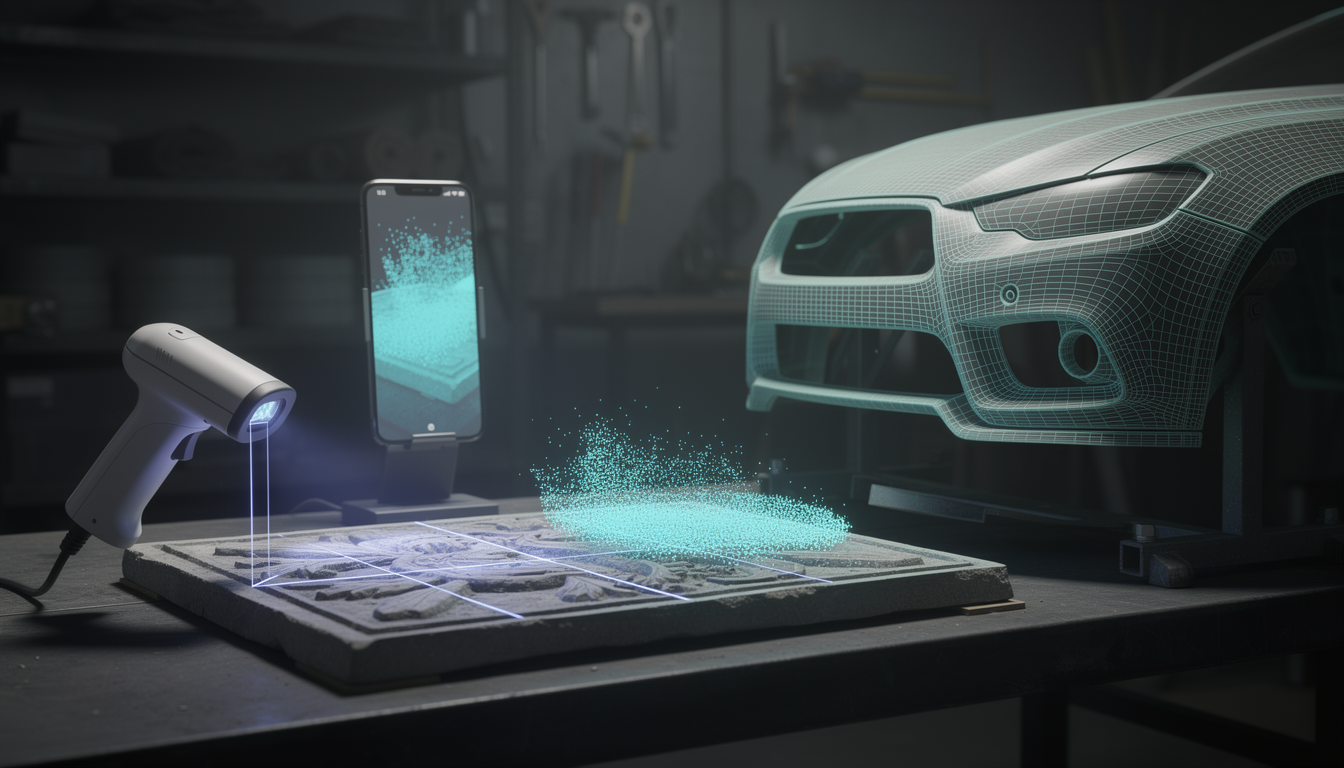
Einstar Rockit and Creality Raptor Pro are both compact, wireless-capable handheld 3D scanners built for hobbyists, engineers and small studios who need portable capture without a full metrology rig. Rockit costs less and pushes far more raw points per second; Raptor Pro publishes a documented volumetric accuracy tolerance and scans much larger objects. The better buy depends on whether budget and throughput or verified precision and scale matter more.
At a Glance
| Category | Einstar Rockit | Creality Raptor Pro |
|---|---|---|
| Price | $1,519 sale (3DJake, as of Sept 2026) | $1,462.67 (Creality official store, as of Sept 2026) |
| Best For | Buyers who want low cost and high point-capture speed | Buyers who need documented accuracy and large-object range |
| Deciding Spec | Up to 2.8 million points/sec; usable to 110,000 lux ambient light | 0.02mm + 0.08mm/m volumetric accuracy; scans up to 4000x4000x4000mm |
Full Spec Comparison
| Axis | Einstar Rockit | Creality Raptor Pro |
|---|---|---|
| Accuracy | Not published as a standalone tolerance figure; precision is expressed through laser line count and point density instead | 0.02mm + 0.08mm/m volumetric accuracy, per manufacturer’s published specs |
| Resolution | 38 crossed blue laser lines for large-area capture, 7 parallel blue laser lines for fine detail, plus IR VCSEL for medium/large objects; 5MP color camera | Dual-mode near-infrared (NIR) light plus 22+7 laser lines for fast, detailed capture |
| Capture Speed | Up to 2.8 million points/sec in Laser HD mode; 1.44 million points/sec in IR Rapid mode | Up to 660,000 points/sec, up to 60fps |
| Working Volume/Range | No maximum object size published; compact handheld form factor is built for small-to-medium parts | Captures objects from 5x5x5mm up to 4000x4000x4000mm |
| Tracking | IR VCSEL supports capture of fast-moving medium and large objects; no separate tracking spec published | Dual NIR/laser modes handle tracking during capture; no separate tracking spec published |
| Weight | Not published by manufacturer as of Sept 2026 | Not published by manufacturer as of Sept 2026 |
| Computer Requirements | Tethers wirelessly to a paired phone, tablet or PC over built-in Wi-Fi | Not specified in currently published specs |
| Software & Subscriptions | Free EXStar scanning app, no subscription required | Not specified in currently published specs |
| Price | $1,519 sale, regular list $1,999 (3DJake, as of Sept 2026) | $1,462.67 (Creality official store, as of Sept 2026) |
Where Rockit Wins
Rockit’s ceiling for raw data capture is much higher: up to 2.8 million points per second in Laser HD mode versus Raptor Pro’s 660,000 points/sec, which matters for anyone scanning texture-rich or large-area surfaces quickly. It also handles ambient light better, rated for use up to 110,000 lux in Laser HD mode and 70,000 lux in IR Rapid mode, so outdoor or brightly lit indoor scanning stays viable without extra shading. At $1,519 on sale, it undercuts Raptor Pro on price while running on a free app with no subscription and a pocket-size, battery-powered, Wi-Fi-tethered design that suits fieldwork.
Where Raptor Pro Wins
Raptor Pro publishes a specific volumetric accuracy tolerance of 0.02mm plus 0.08mm per meter, giving buyers a documented precision figure that Rockit’s spec sheet does not offer, per the manufacturer’s published specs. It also scans a far wider size range, from objects as small as 5x5x5mm up to 4000x4000x4000mm, making it the better fit for anyone who needs to capture large parts, furniture or vehicle-scale objects in one system. Its dual-mode NIR-plus-laser sensor array (22+7 lines) also gives it flexibility between fast coverage and finer detail passes on a single device.
Verdict: Which Should You Buy?
Hobbyists and small studios prioritizing speed, lower upfront cost and bright-light or outdoor flexibility should lean toward Rockit. Engineers and studios that need documented accuracy tolerances and the ability to scan much larger objects will find Raptor Pro the stronger fit. For more on how we build these comparisons, see our editorial policy.
Frequently Asked Questions
Is Einstar Rockit accurate enough for engineering work?
Rockit’s manufacturer specs describe point density and laser line count rather than a single accuracy tolerance, so buyers who need a documented figure for engineering tolerance checks should compare against scanners that publish one, such as Raptor Pro’s 0.02mm + 0.08mm/m rating, per the manufacturer’s published specs.
Can Creality Raptor Pro scan small, detailed objects as well as large ones?
Yes. Per the manufacturer’s published specs, Raptor Pro’s working range spans from 5x5x5mm up to 4000x4000x4000mm, and its 22+7 laser-line dual mode with NIR light is designed to switch between fast large-area coverage and finer detail capture on the same device.
Does either scanner require a subscription to use?
Einstar Rockit runs on the free EXStar scanning app with no subscription required, per the manufacturer’s published specs. Creality has not published software or subscription details for Raptor Pro as of September 2026, so buyers should confirm current app requirements with Creality directly before purchase.