
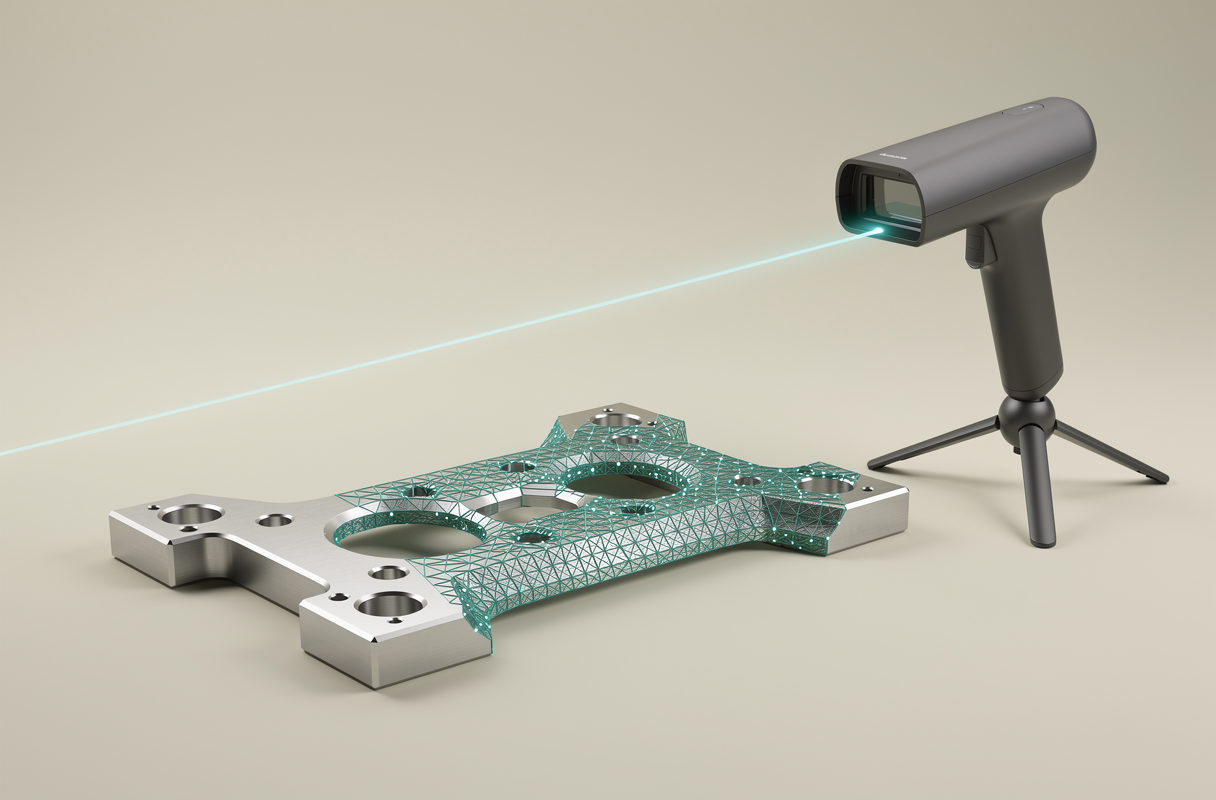
A laser 3D scanner projects one or more thin blue lines across an object and tracks how those lines bend over its surface, calculating geometry from the distortion. That differs from structured-light scanners, which flash broader patterns of white light instead. Laser lines concentrate more energy into a narrow band, so they read dark, shiny, or reflective surfaces with less coaxing and hold up on fine edges and thin features. The five picks below were chosen from manufacturers whose current lineups still include true laser-line hardware, cross-checked against published spec sheets and dated retail pricing.
How We Picked These
Every scanner on this list uses actual laser-line projection, not structured light dressed up as “laser mode” in marketing copy. Selection criteria included published accuracy and volumetric accuracy figures, points-per-second throughput, scan volume range, and confirmed laser line counts, all sourced from manufacturer spec pages rather than third-party estimates. Pricing reflects official store listings as of September 2026, noted separately from any promotional discount so buyers can see both the list price and the current street price. Community test data and reviews are cited where they add context the spec sheet alone doesn’t capture, such as how a unit performs on black plastic or brushed metal without spray. Scanners were sorted into use-case categories — overall value, complex geometry, budget, large-object capture, and standalone professional use — rather than ranked on a single score, since laser scanner buyers tend to have a specific job in mind.
Best Overall Laser Scanner: Revopoint Metro X
The Metro X lists at $999 and has been seen as low as $649 during promotions at the Revopoint official store, as of September 2026. It pairs a blue laser system — 14 crossed lines or 7 parallel lines — with a full-field structured-light mode running 62 lines, so buyers get laser precision on demanding surfaces and faster structured-light capture on everything else. Per the manufacturer’s published specs, accuracy reaches 0.02mm with volumetric accuracy of 0.02mm+0.04mm per meter of travel. Structured-light mode captures up to 7,000,000 points per second; laser mode tops out at 2,000,000 points per second. The package ships with a tripod, turntable, and calibration board, giving makers and engineers a metrology-grade setup without an industrial price tag.
The weakness is practical rather than technical: the full accessory rig, calibration step, and mode-switching add real setup time compared to a simpler handheld-only scanner. Buyers who just want to point and scan in under a minute may find the workflow more involved than expected.
Best for Complex Geometries: Revopoint Metro Y
The Metro Y runs $1,071, with a Pro variant at $1,428, through the Revopoint official store as of September 2026. Unlike the Metro X, it is laser-only, built specifically for intricate parts with fine surface detail. Per the manufacturer’s published specs, single-frame repeatability reaches 0.01mm with accuracy up to 0.02mm, delivered through 30 cross lines, 15 parallel lines, or a single-laser mode depending on the geometry being captured. An integrated HD RGB camera adds color texture, and built-in Wi-Fi 6 supports tethered or wireless capture across a maximum scan volume of 1x1x1 meter.
This is the pick for engineers scanning small, detailed mechanical parts, jewelry masters, or textured surfaces where line density matters more than raw speed. The tradeoff is cost: it carries a higher price than the Metro X while offering a narrower, laser-only feature set, so buyers who also want a fast structured-light mode for large flat surfaces may prefer the hybrid Metro X instead.
Best Budget Laser: Creality CR-Scan Raptor
The CR-Scan Raptor lists at $1,499 but has been selling for $879 at the Creality official store, as of September 2026, making it the least expensive true laser scanner on this list. It projects 7 blue parallel laser lines and, per the manufacturer’s published specs, reaches metrology-grade accuracy up to 0.02mm at 60fps. It covers objects from 5mm to 2000mm and weighs 372g, light enough for extended handheld sessions. Community test data and reviews report it scans black and metal parts without anti-glare spray, a common pain point for lower-cost scanners.
The catch is that the $879 figure is sale pricing, not the everyday list price, so buyers shopping outside a promotional window may pay closer to the $1,499 sticker. Anyone comparing this to the Metro X should check current pricing on both before deciding, since the gap between them narrows or widens depending on which promotions are active.
Best for Large Objects: Creality Raptor Pro
The Raptor Pro lists at $1,462.67 through the Creality official store, as of September 2026. It combines a near-infrared mode with 22 crossed and 7 parallel laser lines, and per the manufacturer’s published specs captures objects from 5mm up to 4000mm — large enough for vehicle body panels, furniture, or full-size fixtures. Throughput reaches up to 660,000 points per second at 60fps, with volumetric accuracy rated at 0.02mm+0.08mm per meter.
That points-per-second figure is the honest tradeoff here: it sits well below the Metro-series scanners’ ceiling, so fine-detail work on small parts isn’t the Raptor Pro’s strength. Its dual-mode design and extended capture range make it better suited to buyers whose primary need is covering large surface area accurately rather than resolving the smallest possible features. For anyone scanning vehicles, boat hulls, or large sculptural work, that range advantage matters more than raw point density.
Best Professional Standalone Laser: EinScan Rigil
The EinScan Rigil lists at $4,999 through Shining3D and retailers like 3DJake, as of September 2026, positioning it well above the rest of this list. It is a tri-mode standalone laser scanner with onboard processing and wireless operation, so it doesn’t need a tethered laptop to run. Per the manufacturer’s published specs, volumetric accuracy reaches 0.04mm+0.06mm per meter with resolution up to 0.05mm, delivered through 25 crossed lines paired with another 25, plus 7 parallel lines. Dual 6,000mAh batteries and a 6.4-inch 2K AMOLED touchscreen let it run untethered through a full scanning session, and it handles carbon fiber, shiny metal, and dark surfaces without spray.
The obvious weakness is price: at $4,999 it costs several times more than any other pick here, putting it out of reach for hobbyists and most small shops. It’s built for professionals — inspection teams, reverse-engineering shops, or field technicians — who need an all-in-one laser rig they can carry to a job site without a workstation in tow.
Frequently Asked Questions
Is laser more accurate than structured light?
Not automatically. Top structured-light scanners can match or beat entry-level laser units on flat, matte surfaces. Laser’s real advantage is consistency on dark, shiny, or reflective materials, where structured light struggles to read the projected pattern. Per the manufacturer’s published specs on the scanners above, the best laser units reach 0.01-0.02mm accuracy, competitive with high-end structured-light hardware.
Do laser scanners need scan spray on shiny parts?
Usually less than structured-light scanners do. Community test data and reviews on the CR-Scan Raptor and EinScan Rigil report clean captures on black plastic and brushed or polished metal without spray, though extremely mirror-like or transparent surfaces can still cause dropouts on any optical scanner, laser included.
Why do some laser scanners also include structured light?
Hybrid designs like the Revopoint Metro X let one device switch modes: structured light for fast, wide-area capture on cooperative surfaces, and laser for detail work or reflective materials. It adds versatility at the cost of a slightly more complex setup and calibration routine compared to a laser-only unit.