
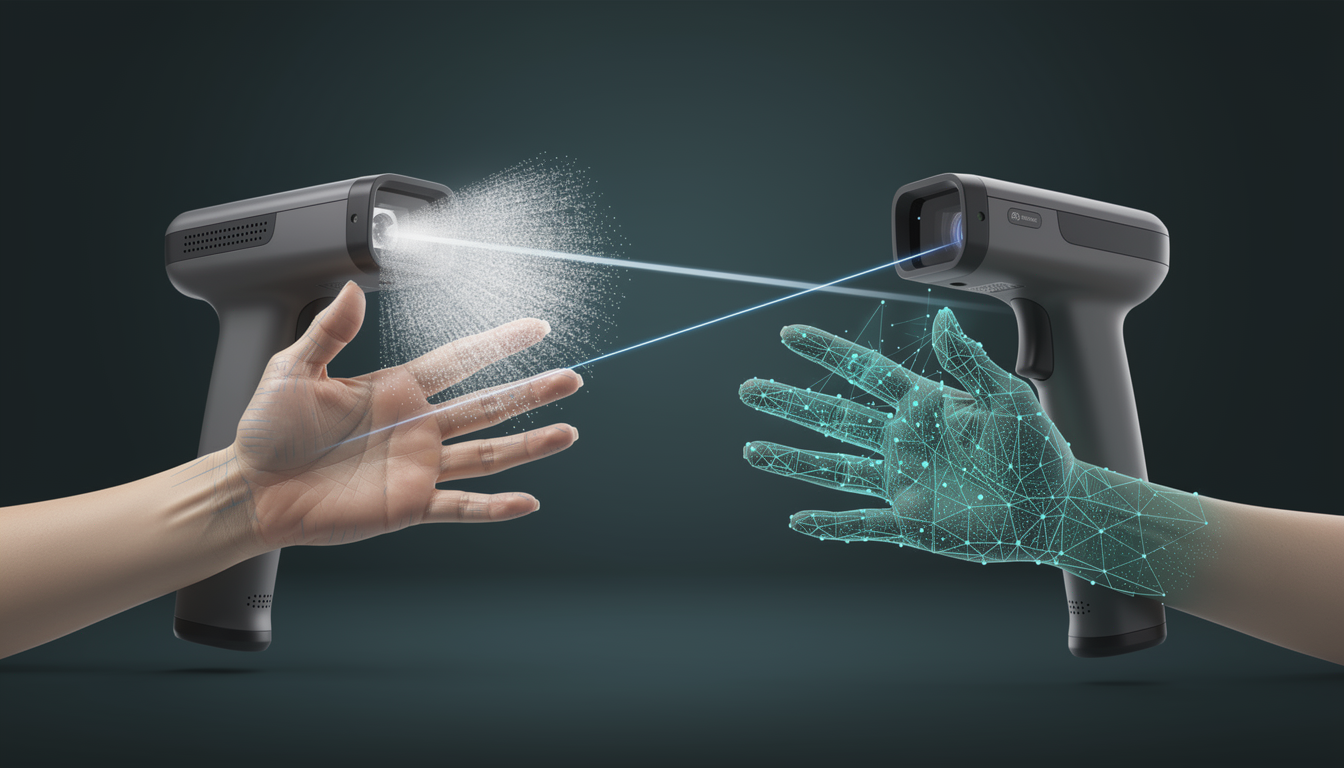
Shoppers comparing the EinScan H2 and EinScan HX are really comparing a current product to a retired one. The H2 is Shining3D’s active hybrid handheld, built for full-color capture on faces, hands and products, while the HX has been discontinued and replaced by the EinScan Rigil. Buyers who want ongoing support and parts should default to the H2; those who find remaining HX stock at a steep discount may still get strong laser accuracy for rigid parts.
At a Glance
- Category: Hybrid handheld 3D scanners (LED + secondary light source)
- EinScan H2: Current model, white LED + infrared VCSEL, up to 0.05mm accuracy, ~€4,999
- EinScan HX: Discontinued, blue LED + blue laser, up to 0.04mm accuracy, was $7,999
- Deciding spec: Availability — the H2 is buyable new with support; the HX is sold out and unsupported going forward
Full Spec Comparison
| Axis | EinScan H2 | EinScan HX |
|---|---|---|
| Accuracy | Up to 0.05mm (LED mode) | Up to 0.04mm; laser precision up to 0.04mm |
| Resolution | Not separately published; tied to 0.05mm accuracy spec | Up to 0.05mm |
| Capture Speed | Up to 1,200,000 points/sec | Up to 1,200,000 points/sec (LED mode) |
| Working Volume/Range | Field of view up to 780x900mm; working distance 200-1500mm | Scan volume 420x440mm (LED mode) / 380x400mm (laser mode) |
| Tracking | Hybrid LED + 3x infrared VCSEL projectors | Hybrid blue LED + blue laser |
| Weight | 731g | Not published in available source data |
| Computer Requirements | Not published in available source data; check Shining3D listing before buying | Not published in available source data |
| Software & Subscriptions | Bundled EXScan software per Shining3D; no separate subscription tier disclosed | Bundled EXScan software per All3DP; no separate subscription tier disclosed |
| Price | Around €4,999 via 3D Wonders, as of September 2026; Shining3D itself sells this tier by quote/demo request rather than a fixed listed price | Discontinued and no longer sold new; last listed at $7,999 per All3DP, referenced as of September 2026 |
Why This Order
The table above runs accuracy first because it drives most buying decisions for scan work, then moves through speed, volume and hardware weight before ending on price — the axis where the HX’s discontinued status matters most.
Where EinScan H2 Wins
The H2 is the only one of the two still in active production, so buyers get current firmware, accessories and manufacturer support rather than betting on leftover stock. Its infrared VCSEL projectors are gentler on skin and hair than a laser, which per Shining3D’s published specs makes it the better pick for scanning people — medical, cosplay and portrait-figurine work included. It also pairs a larger field of view (up to 780x900mm) and a longer adjustable working distance (200mm to 1500mm) with a lower street price around €4,999, undercutting the HX’s original $7,999 list while still hitting 1,200,000 points/sec. That combination of reach and price makes the H2 easier to justify for a studio scanning full-body subjects or bulky products, where the HX’s tighter 420x440mm LED-mode volume would mean more repositioning and stitching.
Where EinScan HX Wins
Where the HX still has an edge is raw accuracy: its blue-laser mode reaches 0.04mm versus the H2’s 0.05mm, a meaningful gap for engineers scanning tight-tolerance mechanical parts. The laser mode also holds up better on reflective or dark surfaces that can trip up LED-only scanning, per All3DP’s published spec review. For a workshop that already owns HX accessories or finds discounted new-old-stock, that laser precision remains genuinely useful — it just comes without a path to future updates. Between its LED mode and laser mode the HX also offers a second capture option in one device, which can help when a project mixes reflective metal parts with matte prototypes on the same bench.
Verdict: Which Fits You?
Artists, medical scanning teams and product designers who need safe, full-color capture of people and products should choose the EinScan H2 — it’s current, cheaper, and built for that job. Engineers chasing sub-0.05mm accuracy on rigid parts who can find remaining HX stock at a discount may still get value from its laser mode, but should budget for eventual replacement given its discontinued status. For more on how we build these comparisons, see our editorial policy.
Frequently Asked Questions
Is the EinScan HX still available to buy new?
No. Shining3D has discontinued the HX and replaced it with the EinScan Rigil. Any HX units on the market are remaining retailer stock or used listings, not manufacturer-fresh inventory, so warranty and long-term software support are limited compared to the H2.
Which scanner is safer for scanning a person’s face or hands?
The EinScan H2 is the better choice for scanning people. Its white LED plus infrared VCSEL light source is gentler than the HX’s blue-laser mode, per Shining3D’s published specs, which is why the H2 is positioned for medical and portrait-style capture work.
Does the accuracy difference between the two scanners matter for most buyers?
The gap is small — 0.04mm on the HX versus 0.05mm on the H2 — and only matters for tight-tolerance engineering or reverse-engineering work. Hobbyists, artists and most product designers will not notice the difference in practice.