
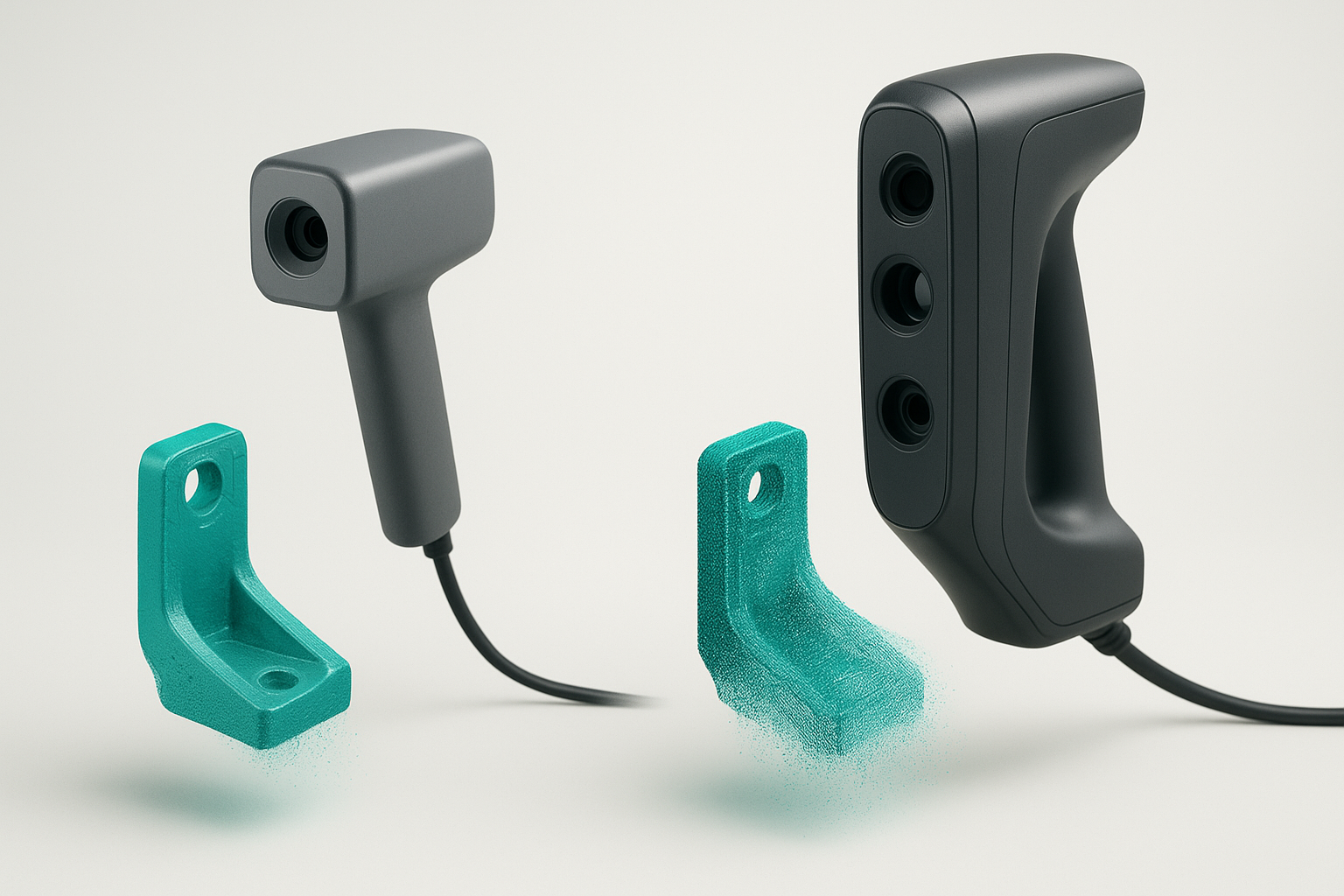
Buyers choosing between EinScan and Artec are really choosing between two philosophies: EinScan builds accessible professional-grade scanners at a fraction of premium pricing, while Artec sells industrial-grade speed and a decades-deep support ecosystem. The right pick depends on whether budget or raw capture speed and brand infrastructure matter more for the project at hand.
At a Glance
- Category: Professional handheld 3D scanners
- EinScan: Pro 2X, ~$5,999, tighter single-scan accuracy (0.04mm), slower capture
- Artec: Eva, reseller-quoted ~$19,800, faster capture (18M pts/sec), broader industrial adoption
- Deciding factor: price tier — EinScan is roughly a third of Artec’s cost
Full Spec Comparison
This table compares the EinScan Pro 2X, the brand’s representative professional handheld, against the Artec Eva, Artec’s mid-tier structured-light scanner, axis by axis. The two scanners target similar handheld-capture use cases, which makes them a fair budget-versus-premium matchup rather than an apples-to-oranges comparison, even though their price gap is roughly threefold.
| Spec | EinScan Pro 2X | Artec Eva |
|---|---|---|
| Accuracy | Up to 0.04mm (single-scan) | Up to 0.1mm |
| Resolution | Not separately published; tied to 0.04mm accuracy spec | Up to 0.5mm 3D resolution; 1.3MP texture resolution |
| Capture Speed | Up to 1,500,000 points/sec (30fps, Handheld Rapid Scan) | Up to 18,000,000 points/sec (16fps) |
| Working Volume/Range | Scan area 150x120mm to 250x200mm | Not specified in source; structured-light handheld range |
| Tracking | Handheld with white LED light, no laser | Structured-light handheld tracking |
| Weight | 2.5lbs / 1.13kg | 0.9kg / 2lb |
| Computer Requirements | Not specified in source | Not specified in source |
| Software & Subscriptions | Four scan modes included (handheld rapid, handheld HD, fixed turntable, fixed tripod) | Sold through resellers; software terms vary by reseller/promotion |
| Price | $5,999 as of September 2026, per Top3DShop | ~$19,800 as of September 2026, reseller-quoted per Aniwaa (Artec has no fixed manufacturer list price) |
Where EinScan Wins
EinScan’s Pro 2X publishes a single-scan accuracy of up to 0.04mm, tighter on paper than Eva’s 0.1mm, at roughly a third of Artec’s reseller-quoted price. That accuracy-per-dollar ratio makes it the stronger pick for buyers who need precise captures without an industrial budget. The Pro 2X also ships with four scan modes — handheld rapid, handheld HD, fixed with turntable, and fixed with tripod — giving small studios and engineering shops flexibility to switch workflows without buying separate hardware. Beyond the Pro 2X, EinScan’s wider line stretches from sub-$2,000 desktop turntables (SE, SP) to laser all-in-one rigs (Rigil) and a €4,999 H2 handheld, so buyers can scale up within one ecosystem as needs grow, rather than committing to premium pricing on day one. For hobbyists testing whether 3D scanning fits their workflow, or engineers who need repeatable accuracy on a departmental budget, that lower entry cost lowers the risk of the purchase itself.
Where Artec Wins
Artec Eva’s headline number is raw throughput: up to 18,000,000 points per second versus the Pro 2X’s 1,500,000, a difference that matters for scanning people, animals, or anything that moves or can’t hold a pose for long. Eva is also lighter at 0.9kg against the Pro 2X’s 1.13kg, easing fatigue during long handheld sessions. Beyond the spec sheet, Artec’s broader catalog — Leo, Space Spider, and industrial metrology scanners — targets clients in medical, heritage-preservation, and industrial inspection work who need an established, widely-validated brand and support infrastructure, something buyers sometimes pay for directly rather than chasing the lowest accuracy figure alone. That infrastructure matters most for teams that need vendor support contracts, validated workflows, or a scanner already accepted in regulated industries, where switching costs and downtime often outweigh the price difference on the spec sheet.
Verdict: Budget or Premium?
Hobbyists, engineers, and small studios watching budget should lean toward the EinScan Pro 2X for its tighter accuracy spec at a fraction of the cost. Studios and enterprises that need Eva’s faster capture speed and Artec’s established industrial support network may find the premium price justified, particularly where downtime or re-scans cost more than the price gap itself. Neither brand is a wrong choice; the deciding question is whether the project’s budget or its capture-speed requirements carry more weight. For more on how we build these comparisons, see our editorial policy.
Frequently Asked Questions
Is the EinScan Pro 2X accurate enough for professional work?
Per the manufacturer’s published specs, the Pro 2X reaches up to 0.04mm single-scan accuracy, tighter than Artec Eva’s 0.1mm figure, making it suitable for engineering and product-design work that demands fine detail on a professional-grade budget.
Why is Artec Eva so much more expensive than EinScan?
Artec Eva is sold through resellers rather than at a fixed manufacturer list price, with Aniwaa quoting around $19,800 as of September 2026. That price reflects Eva’s much higher capture speed (18,000,000 points/sec) and Artec’s broader industrial and medical-market support infrastructure, not just the scanner hardware.
Can EinScan handle fast-moving subjects like Artec Eva can?
Community test data and reviews report that Eva’s 18,000,000-points-per-second capture rate outpaces the Pro 2X’s 1,500,000, so Artec remains the stronger choice for scanning people, animals, or other subjects that can’t hold still for long sessions.
Does the price gap between EinScan and Artec ever narrow?
Sometimes. EinScan’s price is a fixed retailer listing, while Artec Eva is reseller-quoted and subject to periodic promotions, so the roughly threefold gap can shrink temporarily depending on the reseller and timing of a sale — buyers should always confirm a current quote before assuming list pricing applies.