
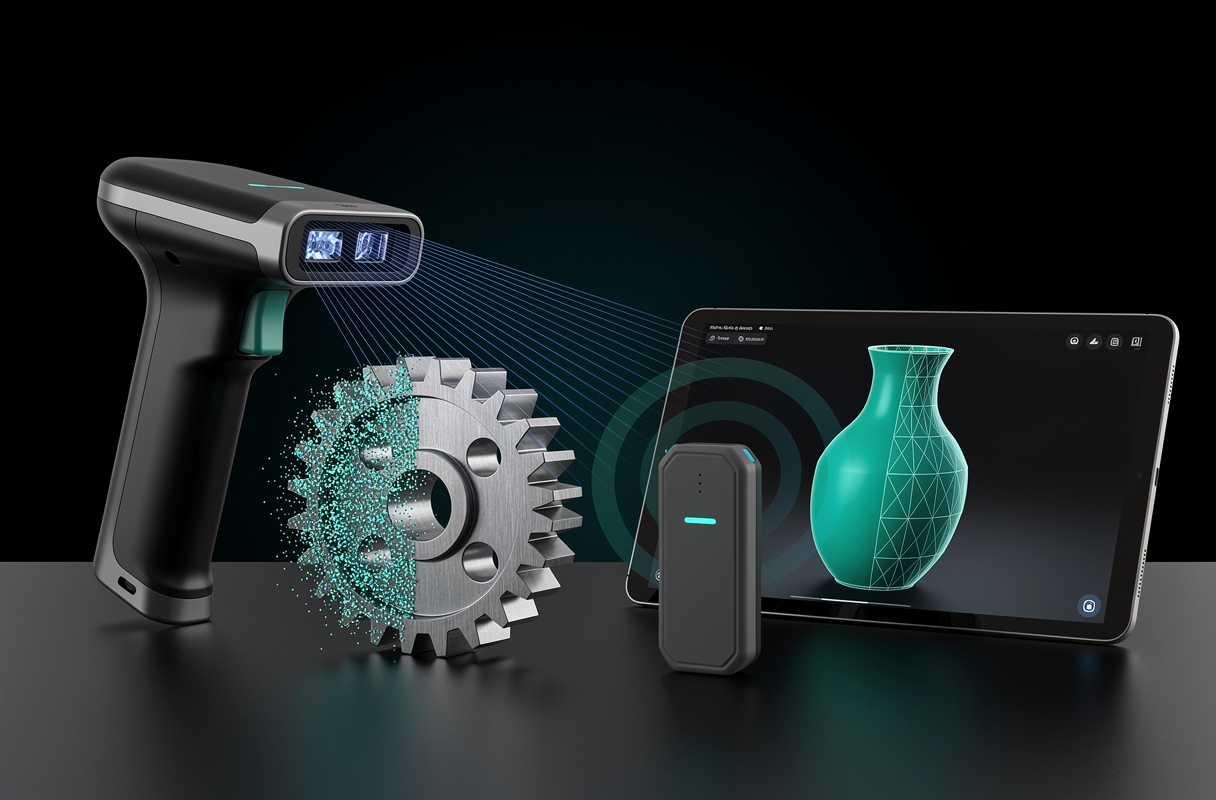
Einstar 2 and Einstar Rockit are both handheld, wireless-capable 3D scanners from Shining3D’s Einstar lineup, aimed at hobbyists, engineers and small studios who need portable capture without a tethered rig. Einstar 2 suits buyers who want higher raw point density; Rockit suits buyers who want a smaller, Wi-Fi-networked scanner for fast, everyday capture.
At a Glance
- Category: Handheld laser + IR hybrid 3D scanners, same Einstar lineup
- Einstar 2: $1,249, finer point distance (down to 0.05mm), 90fps laser capture
- Rockit: $1,519 (sale), pocket-size body, built-in Wi-Fi, higher peak points/sec
- Deciding spec: Einstar 2 wins on point-distance resolution; Rockit wins on portability and peak capture rate
Full Spec Comparison
| Axis | Einstar 2 | Einstar Rockit |
|---|---|---|
| Accuracy | Not separately published by the manufacturer; point distance (below) is the closest published proxy | Not separately published by the manufacturer; see capture speed and light-tolerance figures below |
| Resolution | Point distance down to 0.05mm, per the manufacturer’s published specs | Point distance not published; resolution is expressed via capture-mode point rates instead |
| Capture Speed | Up to 90fps / 2.5 million points/sec in laser mode | Up to 2.8 million points/sec in Laser HD mode; 1.44 million points/sec in IR Rapid mode |
| Working Volume/Range | Roughly 5mm objects up to 10m scenes, switching between laser mode (small/medium objects) and infrared mode (large objects and rooms) | Small-to-large objects and spaces via three capture modes (38-line laser for wide areas, 7-line laser for fine detail, IR VCSEL for medium/large objects); exact volume/range not published |
| Tracking | IR + laser hybrid tracking, no external markers needed for most objects | IR + laser hybrid tracking, no external markers needed for most objects |
| Weight | 420g | Not published; described by the manufacturer as pocket-size for one-handed handheld use |
| Computer Requirements | Paired phone, tablet or PC running the EXStar app for live scanning feedback; no detailed OS/CPU spec published | Same: paired phone, tablet or PC running the EXStar app; adds built-in Wi-Fi for a wireless link to the paired device |
| Software & Subscriptions | EXStar scanning app, free with the scanner, no subscription | EXStar scanning app, free with the scanner, no subscription |
| Price | $1,249, einstar.com official store, as of September 2026 | $1,519 on sale (regular list $1,999), 3DJake, as of September 2026 |
Where Einstar 2 Wins
Einstar 2 pulls ahead on measurement density. Its point distance goes down to 0.05mm per the manufacturer’s published specs, which matters for capturing fine surface detail on smaller parts. It also runs its laser mode at up to 90fps and 2.5 million points/sec, and its dual 2MP 3D cameras plus a 2.3MP texture camera give it a broader working range in a single unit — from roughly 5mm objects to 10m scenes by switching between laser and infrared modes. At $1,249 (einstar.com, as of September 2026), it also undercuts Rockit’s current street price by roughly $270, making it the more budget-friendly of the two despite the finer resolution spec.
Where Rockit Wins
Rockit is built for portability and everyday speed. Its pocket-size body and built-in Wi-Fi let it connect to a paired device without a cable tether, a convenience Einstar 2 doesn’t list. Capture throughput is higher in its top mode — up to 2.8 million points/sec in Laser HD versus Einstar 2’s 2.5 million — and its 38-line crossed laser pattern is aimed at covering large areas quickly. Rockit’s published ambient-light tolerance is also notable: Laser HD mode stays usable up to 110,000 lux and IR Rapid mode up to 70,000 lux, useful for scanning outdoors or under bright shop lighting.
Verdict: Which Should You Buy?
Buyers prioritizing fine surface detail and a lower entry price should lean toward Einstar 2, per its 0.05mm point distance and $1,249 street price as of September 2026. Buyers who value a compact, wireless-networked body and faster peak capture rates for large-area or outdoor work should lean toward Rockit, even at its higher $1,519 sale price. Neither model is a clear loser here — the choice comes down to whether resolution or portability matters more for the job. For more on how we build these comparisons, see our editorial policy.
Frequently Asked Questions
Are Einstar 2 and Rockit made by the same company?
Yes. Both are part of Shining3D’s Einstar sub-brand, so they’re siblings within the same product lineup rather than competing companies. They share the same EXStar scanning app and a similar laser-plus-IR hybrid design.
Do either of these scanners have a built-in screen?
No. Neither Einstar 2 nor Rockit ships with a touchscreen. Both tether to a paired phone, tablet or PC running the EXStar app for live scanning preview and feedback.
Which one is better for scanning large objects or rooms?
Einstar 2’s infrared mode is built for larger objects and scenes up to roughly 10m, per the manufacturer’s specs. Rockit covers similar ground with its 38-line crossed laser and IR VCSEL modes, plus higher published ambient-light tolerance, which can help in bright or outdoor settings.