
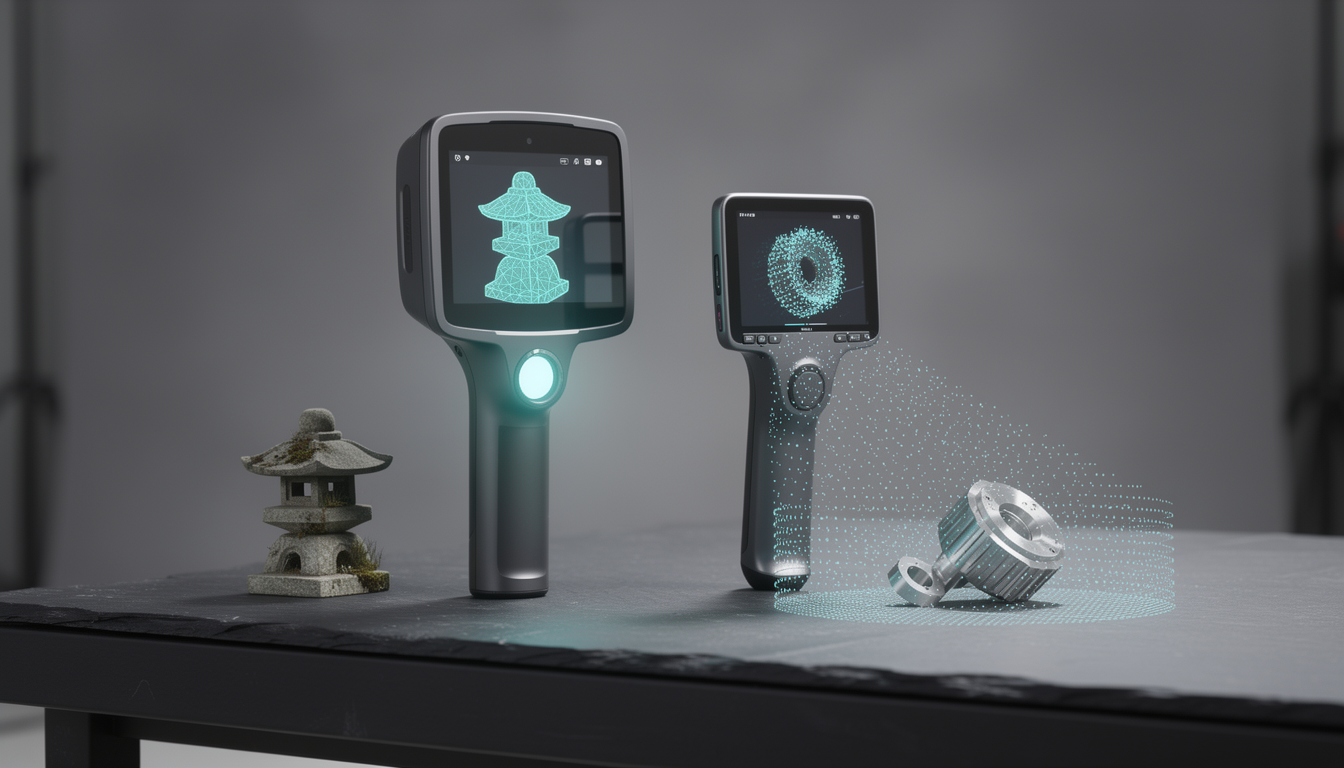
Choosing between the Einstar Vega and the Revopoint Miraco means picking between two standalone, screen-equipped 3D scanners aimed at different jobs. Both skip the laptop entirely, but the Vega leans toward portable field capture in bright or dark conditions, while the Miraco targets precision work with a published sub-millimeter accuracy figure and heavier on-device compute.
At a Glance
- Category: Standalone all-in-one 3D scanners with built-in screens, no PC required
- Einstar Vega: $1,699 (sale), 535g, dual HD/Fast capture modes, built for outdoor and low-light field work
- Revopoint Miraco: $1,525, 750g, 0.02mm precision at 300mm, IP45-rated for studio and rugged field work
- Deciding spec: Miraco’s published 0.02mm-at-300mm accuracy figure vs. Vega’s outdoor/night capture range and lighter build
Full Spec Comparison
| Axis | Einstar Vega | Revopoint Miraco |
|---|---|---|
| Accuracy | No single figure published; precision is expressed through two capture modes (HD infrared MEMS for detail, Fast infrared VCSEL for speed) rather than a stated millimeter tolerance, per manufacturer specs. | 0.02mm single-frame precision at 300mm distance, 0.2mm at 600mm distance, per manufacturer specs. |
| Resolution | 48MP color camera for texture capture; point-cloud resolution not separately published. | 48MP RGB camera paired with a quadruple-depth-camera system for geometry capture. |
| Capture Speed | HD mode (infrared MEMS) for fine detail; Fast mode (infrared VCSEL) up to 20fps on medium/large objects. | Up to 5,000 images per non-color scan, up to 4,000 for color scans, processed via an 8-core 2.4GHz processor. |
| Working Volume/Range | Rated for indoor and outdoor use, including strong sunlight, dark surfaces, and nighttime scanning, per manufacturer specs. | Optimal depth-camera range roughly 300-600mm based on published single-frame precision distances. |
| Tracking | Not detailed in the manufacturer specs reviewed for this comparison. | Not detailed in the manufacturer specs reviewed for this comparison. |
| Weight | 535g | 750g |
| Computer Requirements | None required; on-device processing with a built-in screen, and it can connect to a second screen. | None required; on-device processing via 2K AMOLED 180°-flip touchscreen, 16GB RAM, and 256GB storage. |
| Software & Subscriptions | Post-processing is completed directly on the device; specific software/subscription terms are not detailed in the sourced specs. | On-device processing with Wi-Fi 6 or USB-C 3.1 for data transfer; specific software/subscription terms are not detailed in the sourced specs. |
| Price | $1,699 on sale (regular list $1,999), as of September 2026, via 3DJake / us.einstar.com. | $1,525, as of September 2026, via 3DJake. |
Where Einstar Vega Wins
The Vega’s biggest edge is environmental flexibility. Per its manufacturer specs, it captures indoors and outdoors, including in strong sunlight, on dark surfaces, and at night, a range most standalone scanners do not claim. Its 535g body is noticeably lighter than the Miraco’s 750g, which matters for handheld sessions that run long, and its Fast capture mode reaches up to 20fps on medium and large objects for quicker walk-arounds. Continuous scanning runs 1.5-2 hours before a break is needed. Buyers focused on field capture, creative scanning, or subjects that move between light and shadow gain the most from these traits. The current $1,699 sale price also cuts $300 off its $1,999 list, making the outdoor-capable feature set more attainable than it has been at full price.
Where Revopoint Miraco Wins
The Miraco’s headline strength is a published accuracy number: 0.02mm single-frame precision at 300mm, tightening the gap to dedicated precision scanners. That figure is backed by heavier on-device compute — an 8-core 2.4GHz processor, 16GB RAM, and 256GB storage — plus a 2K AMOLED touchscreen that flips 180 degrees for awkward angles. IP45 dust/splash resistance adds durability for job-site or workshop use that the Vega’s spec sheet does not claim. It also captures more raw frames per scan (up to 5,000 non-color, 4,000 color) and, at $1,525 as of September 2026, undercuts the Vega’s sale price. Reverse-engineering, CAD prep, and other tolerance-sensitive workflows benefit most from this combination.
Verdict: Which Fits Your Workflow?
Field artists, hobbyists, and anyone scanning outdoors or in mixed lighting will get more practical mileage from the Einstar Vega’s lighter frame and documented low-light/outdoor range. Engineers, product designers, and small studios doing reverse engineering or tolerance-critical work should lean toward the Revopoint Miraco for its published 0.02mm accuracy figure and ruggedized, higher-compute hardware. For more on how we build these comparisons, see our editorial policy.
Frequently Asked Questions
Do I need a laptop to run either scanner?
No. Both the Einstar Vega and the Revopoint Miraco are standalone, all-in-one units with built-in screens and on-device processing. The Vega can optionally connect to a second screen, and the Miraco’s screen is a 2K AMOLED display that flips 180 degrees, but neither requires a separate computer to capture or process scans.
Which scanner is better for outdoor or low-light scanning?
The Einstar Vega is the stronger fit here. Per its manufacturer specs, it is built to work indoors and outdoors, including strong sunlight, dark surfaces, and nighttime conditions, a range the Miraco’s published materials do not specifically claim.
Which scanner is more accurate for reverse engineering?
The Revopoint Miraco publishes a specific tolerance: 0.02mm single-frame precision at 300mm distance, widening to 0.2mm at 600mm, per manufacturer specs. The Einstar Vega does not publish an equivalent single accuracy figure, describing precision instead through its HD and Fast capture modes, so buyers who need a documented tolerance for tight-fit or engineering work should weigh that difference carefully.