
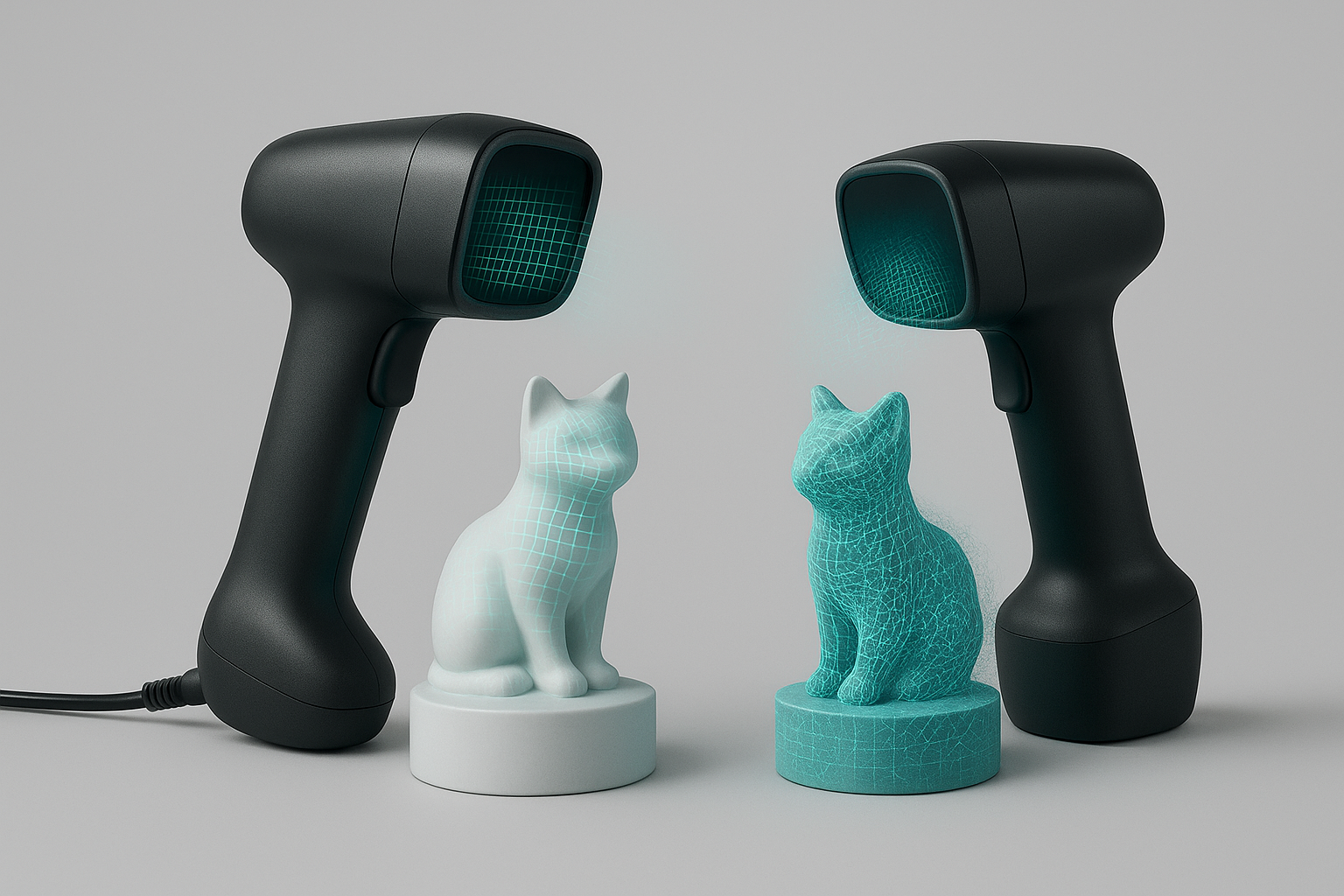
Einstar 2 is worth the extra cost for buyers who need faster capture, an untethered workflow, or finer detail on small parts; owners of the original Einstar who only scan tethered at a desk can likely skip it. The original Einstar costs $699-759 (Vision Miner / Shining3D, as of September 2026), while Einstar 2 runs $1,249 (einstar.com, as of September 2026).
At a Glance
- Category: Einstar vs Einstar 2
- Einstar: $699-759, tethered USB-only, 0.1mm accuracy, up to 14fps
- Einstar 2: $1,249, battery-powered wireless option, 0.05mm accuracy, up to 90fps
- Deciding spec: capture speed — Einstar 2 scans over 6x faster per the manufacturer’s published specs
Full Spec Comparison
| Axis | Einstar | Einstar 2 |
|---|---|---|
| Accuracy | Point distance up to 0.1mm | Point distance down to 0.05mm |
| Resolution | Single RGB color camera plus stereo depth pair | Dual 2MP 3D cameras plus 2.3MP texture camera |
| Capture Speed | Up to 14fps | Up to 90fps / 2.5 million points per second in laser mode |
| Working Volume/Range | Handheld range tuned for small-to-medium objects | Roughly 5mm objects up to 10m scenes via laser (small/medium) and infrared (large) mode switching |
| Tracking | 3 IR VCSEL projectors + 2 stereo depth cameras | 17 parallel blue laser lines + IR VCSEL hybrid |
| Weight | Not specified by manufacturer | 420g |
| Computer Requirements | Tethered PC connection required to operate | Tethered PC connection or standalone battery-powered scanning |
| Software & Subscriptions | Outputs standard mesh formats via bundled software | Outputs STL, OBJ, PLY, 3MF, ASC |
| Price | $699-759 (Vision Miner / Shining3D, as of September 2026) | $1,249 (einstar.com official store, as of September 2026) |
Where Einstar Wins
The original Einstar remains the lower-cost entry point at $699-759 (Vision Miner / Shining3D, as of September 2026), which matters for hobbyists testing whether 3D scanning fits their workflow at all before committing more budget. Its USB-powered, tethered design means no battery to charge, monitor, or eventually replace — plug in and scan, with power and data running over the same cable. The three IR VCSEL projectors and stereo depth camera pair still deliver point distance accuracy up to 0.1mm per the manufacturer’s published specs, which is tight enough for most prototyping and hobbyist reverse-engineering work. For desk-bound scanning of small parts, prototypes, or figurines where 14fps capture is already sufficient, the original hardware covers the job without the added expense of Einstar 2’s laser array and second camera.
Where Einstar 2 Wins
Einstar 2 roughly doubles point-distance resolution to 0.05mm and pushes capture speed to up to 90fps (2.5 million points per second in laser mode), over 6x the original’s 14fps, per the manufacturer’s published specs. The built-in, replaceable battery, absent on the original Einstar, enables roughly 3 hours of untethered scanning, useful for walking around large objects or scenes rather than staying anchored to a laptop. A second 3D camera plus a dedicated 2.3MP texture camera add capture flexibility, and switching between laser and infrared modes extends usable range from roughly 5mm objects up to full 10m scenes, a spread the original single-mode system was not built to cover.
Verdict: Is the Upgrade Worth It?
Owners scanning small, static objects at a desk who already get acceptable results from the original Einstar have little reason to pay the roughly $500-550 premium for Einstar 2. Buyers who need faster capture, finer sub-0.1mm detail, or freedom from a tether — field technicians, studios scanning larger scenes, or anyone regularly hitting the original’s 14fps ceiling — get a meaningful capability jump for that 1.7-1.9x price increase, and the added battery alone changes what jobs are practical to take on-site. For more on how we build these comparisons, see our editorial policy.
Frequently Asked Questions
Can Einstar 2 use the same software and files as the original Einstar?
Both scanners work with Shining3D’s Einstar ecosystem, and Einstar 2 exports common mesh formats including STL, OBJ, PLY, 3MF, and ASC per the manufacturer’s published specs, which keeps output compatible with most downstream CAD and 3D printing tools regardless of which scanner captured the data.
Does Einstar 2’s wireless mode replace tethered scanning entirely?
No. Einstar 2 supports both tethered PC connection and standalone battery-powered scanning, so buyers who prefer working plugged into a computer for live mesh preview can still do so, while the roughly 3-hour battery only adds an untethered option rather than removing the tethered one.
Is the original Einstar still worth buying new in 2026?
At $699-759 (Vision Miner / Shining3D, as of September 2026), the original Einstar remains a viable low-cost entry into handheld 3D scanning for buyers whose projects don’t demand Einstar 2’s higher frame rate or finer 0.05mm accuracy, particularly for desk-based, tethered workflows.
How big is the price gap between the two scanners?
Einstar 2 lists at $1,249 (einstar.com official store, as of September 2026) against $699-759 for the original Einstar (Vision Miner / Shining3D, as of September 2026), a gap of roughly $500-550, or about 1.7-1.9x the original’s price depending on which retailer’s listing is used for comparison.