
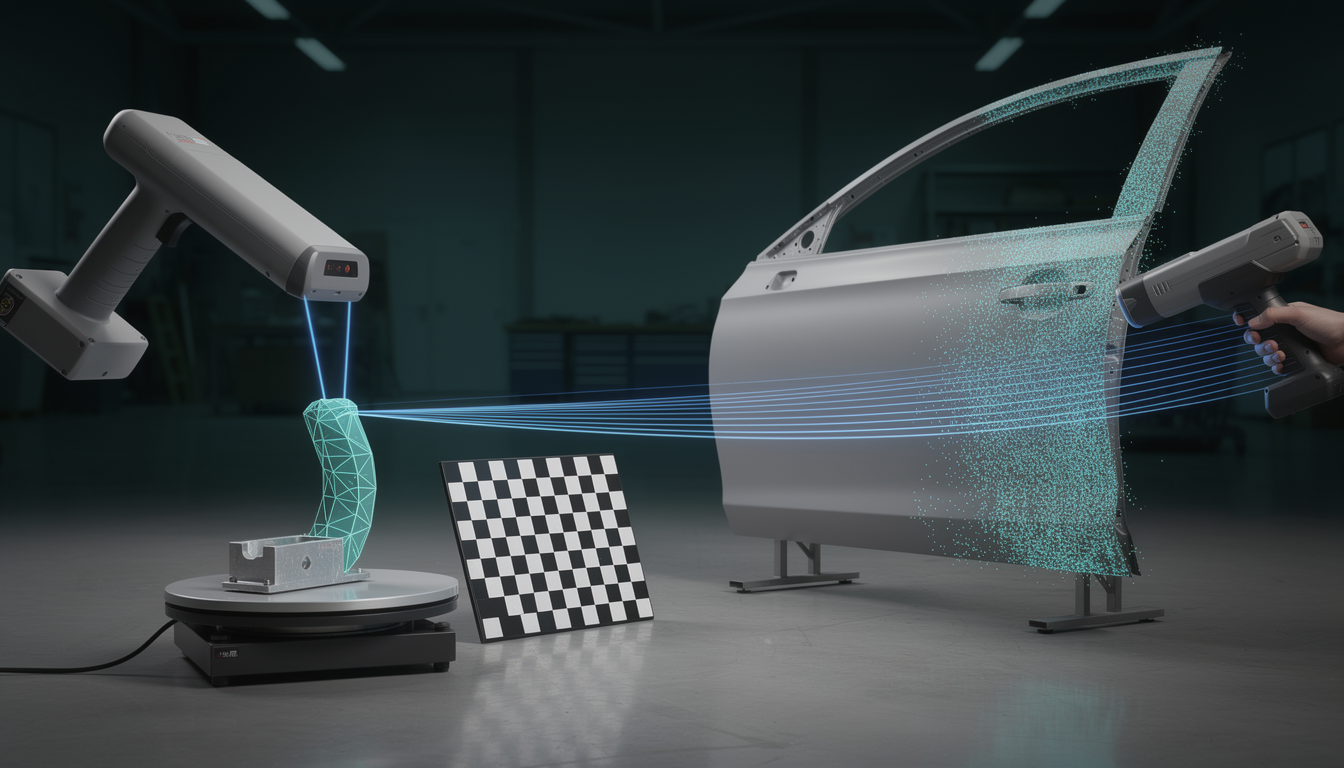
Buyers choosing between the Revopoint Metro X and the Creality Raptor Pro are picking between two metrology-grade 3D scanners built for reverse engineering and quality inspection, not two casual hobbyist devices. The Metro X costs less and captures data faster on small parts; the Raptor Pro costs more but covers a far larger working volume. The right pick depends on part size.
At a Glance
- Category: Metrology-grade 3D scanners for reverse engineering and quality inspection
- Revopoint Metro X: $999 list, hybrid laser plus structured-light, full metrology accessory kit included
- Creality Raptor Pro: $1,462.67 list, dual NIR/laser capture, working volume up to 4000x4000x4000mm
- Deciding spec: Working volume/range — Metro X is tabletop-optimized, Raptor Pro scales to full vehicle-panel-sized objects
Full Spec Comparison
| Axis | Revopoint Metro X | Creality Raptor Pro |
|---|---|---|
| Accuracy | Up to 0.02mm; volumetric accuracy 0.02mm + 0.04mm x L(m) | Volumetric accuracy 0.02mm + 0.08mm/m |
| Resolution | Blue laser: 14 crossed lines / 7 parallel lines; structured light: 62 lines, 4 scanning modes | Near-infrared (NIR) light plus 22+7 laser lines |
| Capture Speed | Up to 7,000,000 points/sec (structured light); up to 2,000,000 points/sec (multi-line laser); up to 60fps | Up to 660,000 points/sec; up to 60fps |
| Working Volume/Range | Field of view 160x70mm at 200mm distance to 320x215mm at 400mm distance | 5x5x5mm up to 4000x4000x4000mm |
| Tracking | Included calibration board and markers plus dual-axis turntable for tabletop alignment | Manufacturer does not publish detailed tracking-mode specs beyond the dual NIR/laser capture system |
| Weight | Not published by manufacturer | Not published by manufacturer |
| Computer Requirements | Tethered to a Windows PC for full-feature software | Tethered to a Windows PC for full-feature software |
| Software & Subscriptions | Revo Metro / Revo Design, free, no subscription | Not detailed in sourced manufacturer specs |
| Price | $999 list, promotional pricing as low as $649, as of September 2026 (Revopoint official store / 3D Printing Industry) | $1,462.67 list, as of September 2026 (Creality official store) |
Where Metro X Wins
The Metro X undercuts the Raptor Pro on price by several hundred dollars, with promotional pricing per Revopoint’s official store and 3D Printing Industry pushing the street price as low as $649 as of September 2026. Its structured-light mode also claims up to 7,000,000 points per second, more than ten times the Raptor Pro’s published 660,000 points/sec ceiling, which per the manufacturer’s specs should mean denser captures per pass on small to mid-size parts. It also ships as a complete tabletop metrology kit — tripod, scanner cradle, dual-axis turntable, calibration board and markers, and a carrying case are all included, and its software runs with no subscription fee.
Where Raptor Pro Wins
The Raptor Pro’s headline advantage is scale: its published working range runs from 5x5x5mm up to 4000x4000x4000mm, letting it capture objects like vehicle panels or large tooling that sit well outside the Metro X’s tabletop-oriented field of view of roughly 160x70mm to 320x215mm. Its dual near-infrared and laser (22+7 line) capture system is built specifically to handle that range of part sizes without swapping hardware. The tradeoff is a slightly looser volumetric accuracy tolerance — 0.08mm/m versus the Metro X’s 0.04mm/m — a reasonable compromise per the manufacturer’s specs for scanners this size.
Verdict: Which Should You Buy?
Hobbyists, engineers and small studios scanning tabletop parts, prototypes, or small mechanical components should lean toward the Metro X for its lower price, faster raw point capture, and included accessory kit. Shops that regularly need to digitize large objects — automotive panels, furniture, or industrial tooling — get more practical value from the Raptor Pro’s much larger working volume, even at a higher price and a slightly looser accuracy tolerance. For more on how we build these comparisons, see our editorial policy.
Frequently Asked Questions
Which scanner is more accurate?
Per the manufacturer’s published specs, the Metro X has a tighter volumetric accuracy tolerance (0.02mm + 0.04mm x L(m)) than the Raptor Pro (0.02mm + 0.08mm/m), meaning accuracy degrades less over larger scan distances. Both list a base accuracy of 0.02mm on small parts, so the gap widens mainly as the object being scanned gets bigger.
Can either scanner handle large objects like a car body panel?
The Raptor Pro is built for this — its published working range extends to 4000x4000x4000mm, well beyond typical panel dimensions. The Metro X’s field of view tops out around 320x215mm at its maximum working distance, making it a better fit for parts, prototypes, and small assemblies rather than full panels.
Do either of these scanners require a subscription?
The Metro X runs on Revopoint’s Revo Metro / Revo Design software at no subscription cost, per the manufacturer’s product page. Creality’s sourced specs for the Raptor Pro do not detail its software licensing terms, so buyers should confirm current software and subscription terms directly with Creality before purchase.