
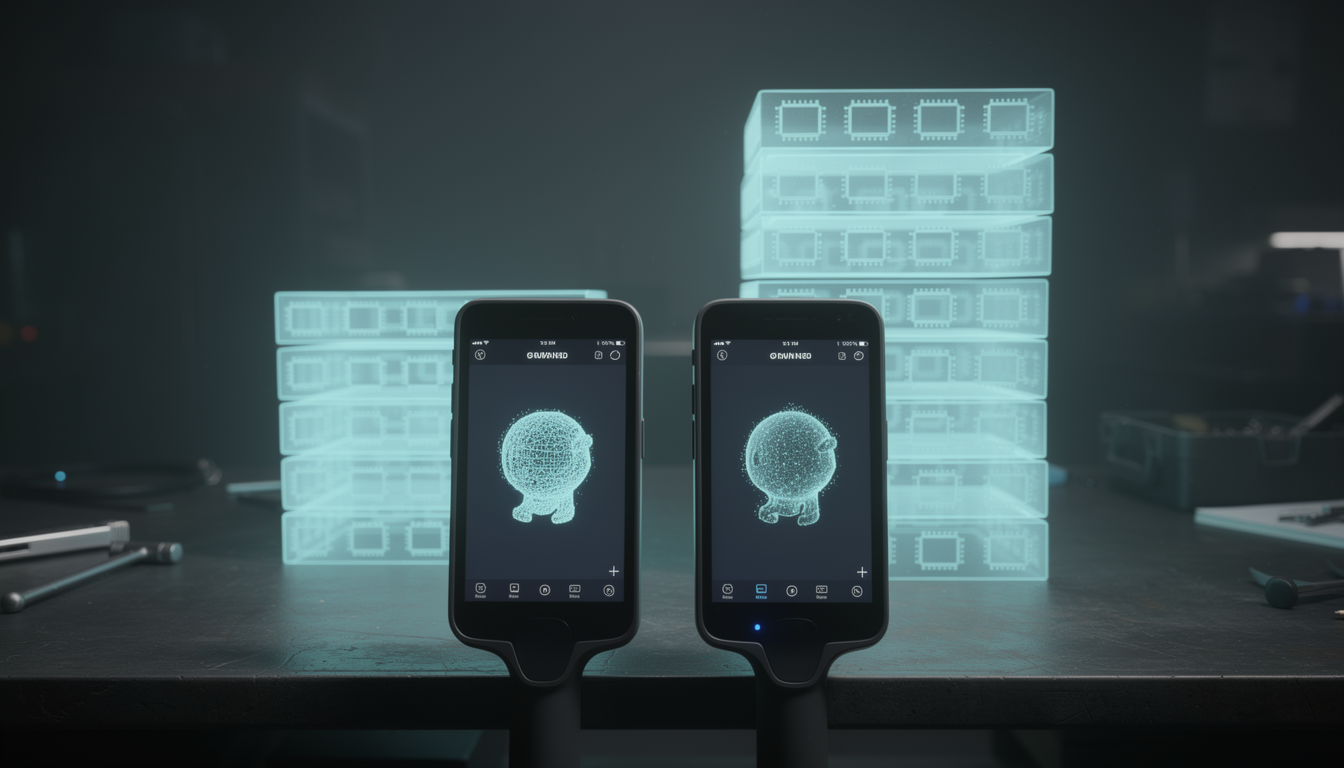
The Revopoint Miraco and Miraco Pro share the same body, cameras, and accuracy specs — the Pro’s extra $275 buys double the RAM and double the single-scan frame buffer. Buyers scanning small parts or short sessions can save money with the standard Miraco; those capturing large objects or long continuous passes without pausing to offload data get more headroom from the Pro.
At a Glance
- Category: Standalone all-in-one 3D scanner
- Miraco: 16GB RAM, buffers up to 5,000 frames (non-color) / 4,000 (color)
- Miraco Pro: 32GB RAM, buffers up to 10,000 frames (non-color) / 8,000 (color)
- Deciding spec: capture-buffer capacity for long or large single-pass scans
Full Spec Comparison
| Axis | Miraco | Miraco Pro |
|---|---|---|
| Accuracy | Up to 0.02mm single-frame precision at 300mm; 0.2mm at 600mm | Up to 0.02mm single-frame precision at 300mm; 0.2mm at 600mm |
| Resolution | 48MP RGB camera, quadruple-depth-camera system | 48MP RGB camera, quadruple-depth-camera system |
| Capture Speed | Same depth-camera and processor architecture as Miraco Pro | Same depth-camera and processor architecture as Miraco |
| Working Volume/Range | Effective range spans roughly 300mm to 600mm per manufacturer specs | Effective range spans roughly 300mm to 600mm per manufacturer specs |
| Tracking | Quadruple-depth-camera tracking, standalone (no external markers needed) | Quadruple-depth-camera tracking, standalone (no external markers needed) |
| Weight | 750g | 750g |
| Computer Requirements | None required — standalone unit with 2K AMOLED 180°-flip touchscreen; USB-C 3.1 or Wi-Fi 6 for transfer | None required — standalone unit with 2K AMOLED 180°-flip touchscreen; USB-C 3.1 or Wi-Fi 6 for transfer |
| Software & Subscriptions | 8-core 2.4GHz processor, 16GB RAM, 256GB storage, 5,000mAh battery (50W fast charge, up to 2 hours scanning), IP45 rated | 8-core 2.4GHz processor, 32GB RAM, 256GB storage, 5,000mAh battery (50W fast charge, up to 2 hours scanning), IP45 rated |
| Price (as of September 2026) | $1,525 (3DJake) | $1,799.59 (3DJake) |
Where Miraco Wins
The standard Miraco delivers identical accuracy, camera resolution, and tracking to the Pro model per the manufacturer’s published specs, but for roughly $275 less. For hobbyists and small studios scanning parts, figurines, or objects that fit within a few thousand frames per session, the 16GB RAM configuration and 5,000-frame (non-color) or 4,000-frame (color) buffer covers most everyday jobs without hitting a ceiling. Its 750g body, 5,000mAh battery rated for up to two hours of continuous scanning, and IP45 rating make it just as field-ready as the Pro. Buyers who plan to offload or process scans in shorter sessions — rather than one uninterrupted marathon capture of a large object — get the same core hardware and image quality for a lower entry price, making the Miraco the more budget-efficient pick when the extra buffer headroom isn’t a limiting factor.
Where Miraco Pro Wins
The Miraco Pro’s doubled 32GB RAM and doubled frame buffer — up to 10,000 images for non-color scans and 8,000 for color scans, per 3DJake’s published specs — let it hold far more data in a single scanning session before needing to pause and offload. That matters most for scanning large objects (vehicles, furniture, statues) or for long, uninterrupted capture passes where stopping mid-scan to manage storage would break tracking continuity. Because the underlying cameras, accuracy, and processor are unchanged, the Pro doesn’t scan faster or more precisely — it simply lasts longer in one continuous pass, which is the specific problem it’s built to solve for engineers and studios working on bigger, buffer-hungry projects.
Verdict: Which Should You Buy?
Hobbyists, students, and small studios scanning smaller objects or working in shorter sessions should buy the standard Miraco — it delivers the same accuracy and camera hardware for about $275 less, as of September 2026 pricing from 3DJake. Engineers and studios who regularly scan large objects or need to capture thousands of frames in one uninterrupted pass should choose the Miraco Pro for its doubled RAM and buffer capacity. For more on how we build these comparisons, see our editorial policy.
Frequently Asked Questions
Is the Miraco Pro more accurate than the standard Miraco?
No. Both models share identical single-frame precision specs — up to 0.02mm at 300mm distance and 0.2mm at 600mm distance — per the manufacturer’s published specifications. The Pro’s advantage is capture buffer and RAM, not accuracy.
Will the extra RAM on the Miraco Pro make scanning faster?
The Pro doesn’t scan faster; both units run the same 8-core 2.4GHz processor and quadruple-depth-camera system, and both report identical single-frame precision figures. The extra 16GB of RAM instead raises the ceiling on how many frames (up to 10,000 non-color or 8,000 color) can be held in a single session before offloading, which is a capacity gain rather than a speed gain.
Which scanner is better for scanning large objects like a car or a statue?
The Miraco Pro is the better fit for large or long-duration scans because its doubled frame buffer lets it capture more images in one continuous session without interrupting tracking to offload data, per 3DJake’s and 3D Printing Industry’s published specifications. For smaller subjects that finish well under a few thousand frames, the standard Miraco reaches the same result for less money.